
What size meat grinder do I need? The numbers confuse everyone at first. #8, #12, #22. They look like model numbers, but they are head sizes, and the head size decides how fast you grind, how big your chunks can be, and, in a way most guides skip, how much meat gets left behind inside the machine.
The standard advice is “buy bigger than you need,” and there is real wisdom in it. Hunters on grinding forums repeat it like scripture: buy bigger than you think you need. But a bigger head holds more meat in the auger and throat, which means more waste per batch when you only grind a few pounds at a time. A #22 that leaves a quarter pound in the head is a rounding error on a deer. It is a real loss on two pounds of burger meat.
So this guide does two things. First, the cheat sheet: what each head size actually means in throat diameter and throughput. Second, the part other guides miss: matching the head to your batch size, so you are not paying for capacity that costs you meat.
Along the way, we use real machines as examples. The Sunmile SM-G73 shows what a #8 looks like in practice. The STX Turboforce 3000 and its bigger sibling the Turboforce II 4000 are classic #12s. The Weston Pro Series 1500W is the #22 bruiser. And the LEM Big Bite line spans all three sizes, which is exactly why hunters swear by it.
- Head size = grinding head diameter. #8, #12, and #22 are the home standards. #5 is small-household territory, #32 is commercial.
- #8 suits up to about 5 lbs per session. #12 covers most households and hunters up to 20+ lbs. #22 is for deer, bulk beef buys, and sausage days.
- Bigger heads retain more meat per batch. Match the head to your batch size, not your ambitions.
- “Buy bigger than you need” is good advice, one step up, not three. A #12 for a #8 job is smart. A #22 for a #8 job is wasteful.
- Bone grinding needs more than size. Only the STX Turboforce II 4000 (soft bones) and the LEM Big Bite #12 (chicken bones) in this guide are rated for it.
What Size Meat Grinder Do I Need: Top Picks at a Glance
Sunmile SM-G73
Small batches, minimal waste. About 3 lbs per minute with a reverse switch and ETL certification.
STX Turboforce 3000
The default answer. 180 to 240 lbs per hour, 3-year warranty, the best-selling home grinder for years.
STX Turboforce II 4000
Air-cooled for long sessions and rated for soft bones. The hunter’s #12.
Weston Pro Series 1500W
12 to 18 lbs per minute of commercial-grade muscle. Buy-it-for-decades build, 5-year warranty.
LEM Big Bite Line
All-metal gears and a 5-year warranty across #8, #12, and #22. Listing unverified.
Head Size Cheat Sheet
| Head Size | Throat Diameter | Typical Throughput | Typical Motor | Who It’s For |
| #5 | ~2″ | ~4 lbs/min | 0.35-0.6 HP | Small households, occasional grinding |
| #8 | ~2″ | ~7 lbs/min | 0.5 HP | Up to ~5 lbs per session |
| #12 | ~2.25″ | ~11 lbs/min | 0.75 HP | Most households, hunters, 5-20 lbs |
| #22 | ~3″ | ~13 lbs/min | 1 HP | Deer, bulk buys, 20+ lbs per session |
| #32 | ~3″+ | ~17 lbs/min | 1.5 HP | Commercial or very heavy home use |
A few things worth noticing in that table. The jump from #8 to #12 is the meaningful one for most buyers: a wider throat (2.25″ vs 2″) and nearly double the typical throughput. The jump from #12 to #22 is smaller on paper (~11 to ~13 lbs/min typical), but the wider 3″ throat and heavier build are what let a #22 chew through a deer without slowing down. And #32 is included for completeness, but almost no home buyer needs one.
The Meat-Waste Problem Nobody Mentions
Every grinder leaves meat behind. After the last piece goes through, some amount stays in the auger, the throat, and the head. On a #8, owners report it is a couple of ounces. On a #22, it is meaningfully more. This is physics, not a defect: a bigger head has more internal volume to fill before meat starts coming out the plate.
Do the math on your batch size. If you grind 3 lbs on a #22 and leave a quarter pound behind, you lost roughly 8% of your meat to the machine. Grind 40 lbs on the same machine and that quarter pound is a rounding error. This is why the “right” size depends on your batch, not your ambition.
Grinding forums have figured this out the hard way. One rokslide poster put it plainly: “A #42 grinder will leave much more inside the body than a #12, so if you are only grinding 10-15 lbs at a time you will lose a much higher percentage of meat.” Scale that down to home sizes and the same logic holds between #8, #12, and #22. The machine does not care about your plans. It cares about its own volume.
“Buy Bigger Than You Need,” With a Catch
The most repeated advice in grinding circles is “buy bigger than you think you need,” and it exists for good reason. An underpowered grinder stalls, overheats, and dies young. A machine running at half capacity lasts far longer than one running at its limit every session. Hunters who try to process a deer a year on a #8 learn this the expensive way.
The catch is the waste problem above, plus cost and counter space. A #22 is a serious piece of equipment: the LEM Big Bite #22 weighs about 50 lbs, and the Weston Pro is a commercial-grade bruiser. They also cost multiples of a good #8. Our rule is simple: buy one size up from your current batch size, not three.
Grinding 5 lbs a month? A #12 gives you headroom without the waste penalty of a #22. Grinding a deer every fall plus monthly sausage batches? Skip straight to a #12 with cooling for long sessions, or a #22 if the batches are big. The sweet spot is a machine that handles your biggest realistic day without making your smallest day wasteful.
What Size Do You Actually Need?
| Your Situation | Head Size | Example Machine |
| Under 5 lbs per session, burgers and sausage | #8 | Sunmile SM-G73 |
| 5-20 lbs, monthly grinding, first deer | #12 | STX Turboforce 3000 |
| Regular hunter, multiple deer, long sessions | #12 step-up | STX Turboforce II 4000 |
| Whole deer in a day, bulk beef buys | #22 | Weston Pro Series 1500W |
| Want all-metal gears and a 5-year warranty | #8 / #12 / #22 | LEM Big Bite line |
If you only remember one row: the #12 is the default answer for most buyers. It is the size where home grinding stops feeling like a compromise.
Detailed Reviews
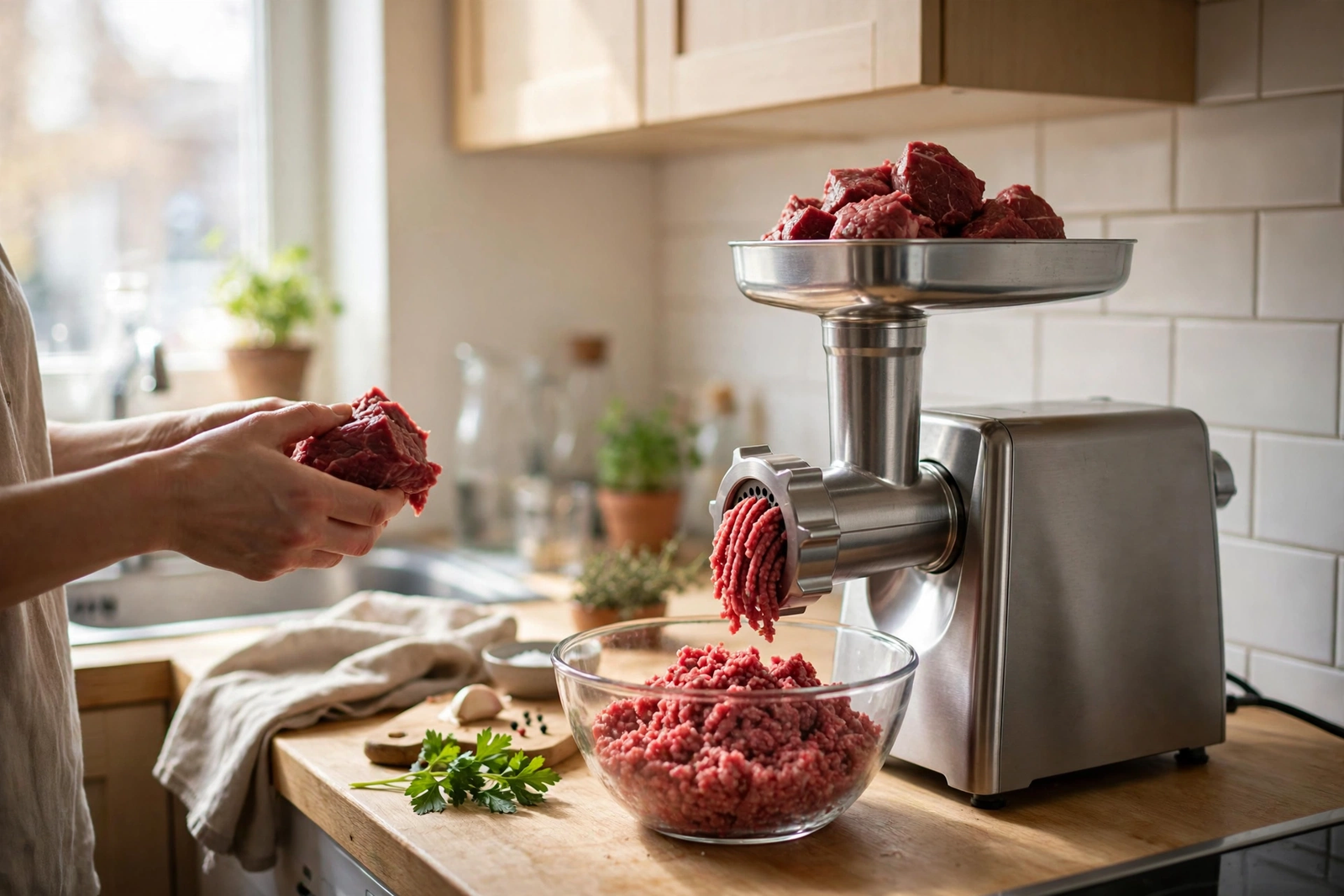
1 Sunmile SM-G73
The #8 ExampleThe SM-G73 is what a good #8 looks like. The #8 head moves roughly 3 lbs per minute in real-world use, which means a 5-lb batch of burger meat is done in a couple of minutes. The throat is about 2 inches, so you will cut your meat into modest chunks, but for small batches that is barely a chore. Thousands of owner ratings describe the same experience: steady, uncomplaining, and easy to clean.
This is also the size where the waste math works in your favor. The small head retains very little per batch, so grinding 2 or 3 lbs for tonight’s burgers loses almost nothing to the machine. The reverse switch clears the occasional sinew wrap without disassembly, and ETL certification covers the electrical safety box. The limits are honest ones: the 600W rated motor and #8 head are not built for 20-lb sessions, and owners report the motor runs warm if you push it.
Who it is for: households grinding under 5 lbs per session, burger blends, small sausage batches, anyone whose priority is minimal waste on small batches. Who should skip: hunters and bulk buyers. If your typical session is 10+ lbs, the #12 picks below will save you real time.
| Head Size | #8 |
| Motor | 1000W max (600W rated) |
| Throughput | About 185 lbs/hour (roughly 3 lbs/min) |
| Plates & Attachments | 3 cutting plates + sausage stuffing attachment |
| Controls | ON/OFF/REVERSE switch |
| Certification | ETL certified |
| Weight | About 12-12.5 lbs |
| Warranty | 1 year |
- Minimal meat waste on small batches
- Reverse switch clears jams fast
- ETL certified, thousands of owner ratings
- Light and easy to store
- Not built for 20-lb sessions
- Motor runs warm when pushed
- Smaller throat means more pre-cutting
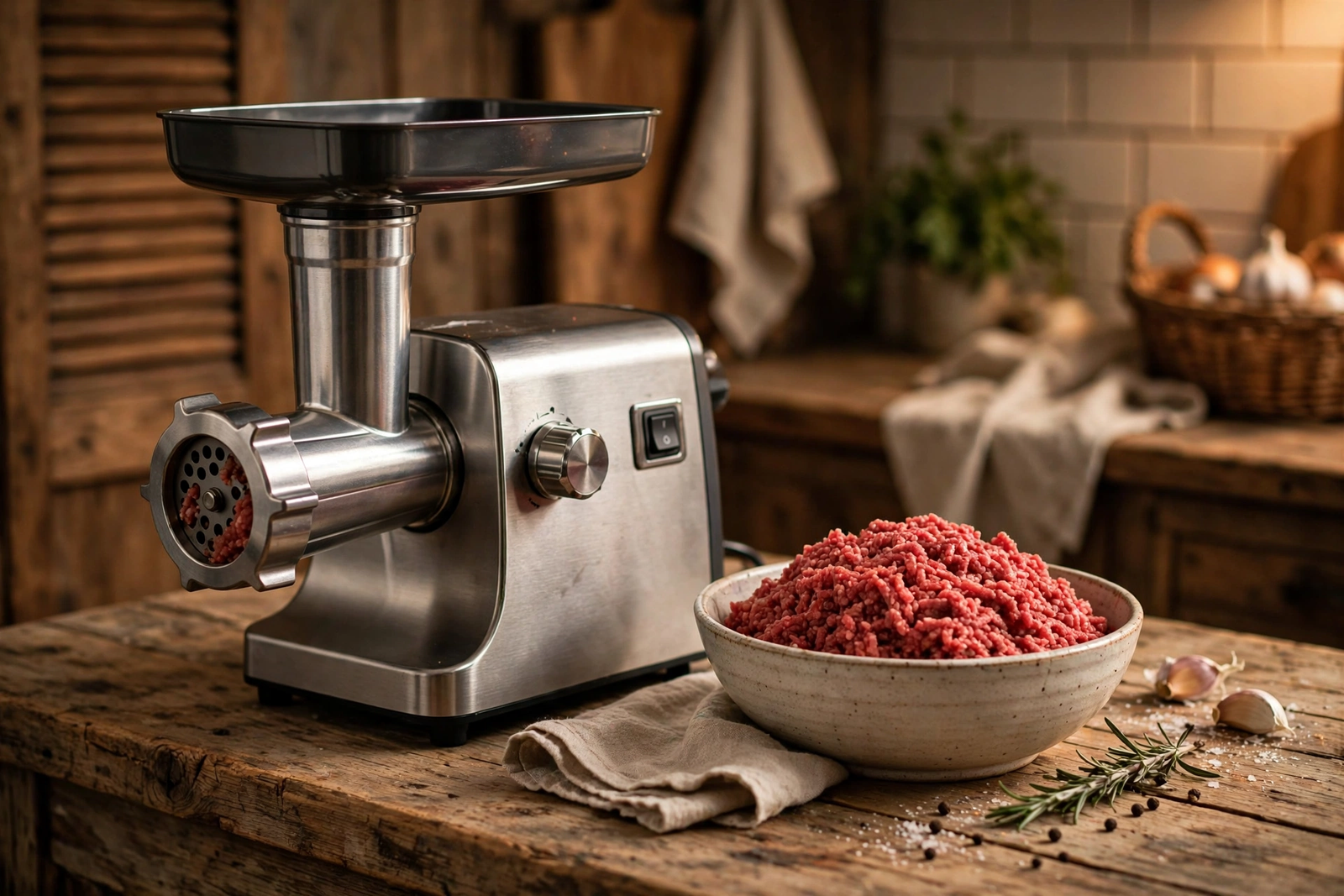
2 STX Turboforce 3000
The #12 StandardThe Turboforce 3000 has been the best-selling home grinder on Amazon for years, and the #12 head is a big part of why. At 180 to 240 lbs per hour, it processes roughly four times what the #8 above manages, and the 2.25″ throat swallows bigger chunks with less pre-cutting. The Advanced Variable Intake is STX’s answer to the classic problem of the auger starving or flooding: it meters the feed so the grind stays consistent.
The bundle is generous in a way budget machines never are: three blades, three plate sizes, three sausage tubes, a kubbe maker, and a foot pedal on most bundles, which matters more than it sounds when both hands are busy feeding meat. The 3-year warranty is triple the budget-tier standard. One hard limit, and STX is explicit about it: this machine will NOT grind bones. Do not try.
Who it is for: the default #12 buyer. Monthly grinders, first-time deer processors, households doing 5-20 lb sessions who want the one machine that covers almost everything. Who should skip: small-batch-only grinders who will waste more per batch on the bigger head, and anyone who needs bone grinding (see the Turboforce II below).
| Head Size | #12 |
| Motor | 3000W max locked (800-1200W under load) |
| Throughput | 180 to 240 lbs per hour |
| Blades & Plates | 3 stainless blades, plates in 4mm / 7mm / 10mm |
| Attachments | 3 sausage stuffing tubes, kubbe maker, foot pedal (most bundles) |
| Feed System | Advanced Variable Intake (AVI) |
| Weight | About 12 lbs |
| Bones | NOT for bones (STX explicit) |
| Warranty | 3 years |
- The #12 sweet spot for most buyers
- Best-selling home grinder for years
- Generous bundle: 3 blades, 3 plates, foot pedal
- 3-year warranty
- Will NOT grind bones, full stop
- More retained meat per batch than a #8
- No air cooling for very long sessions
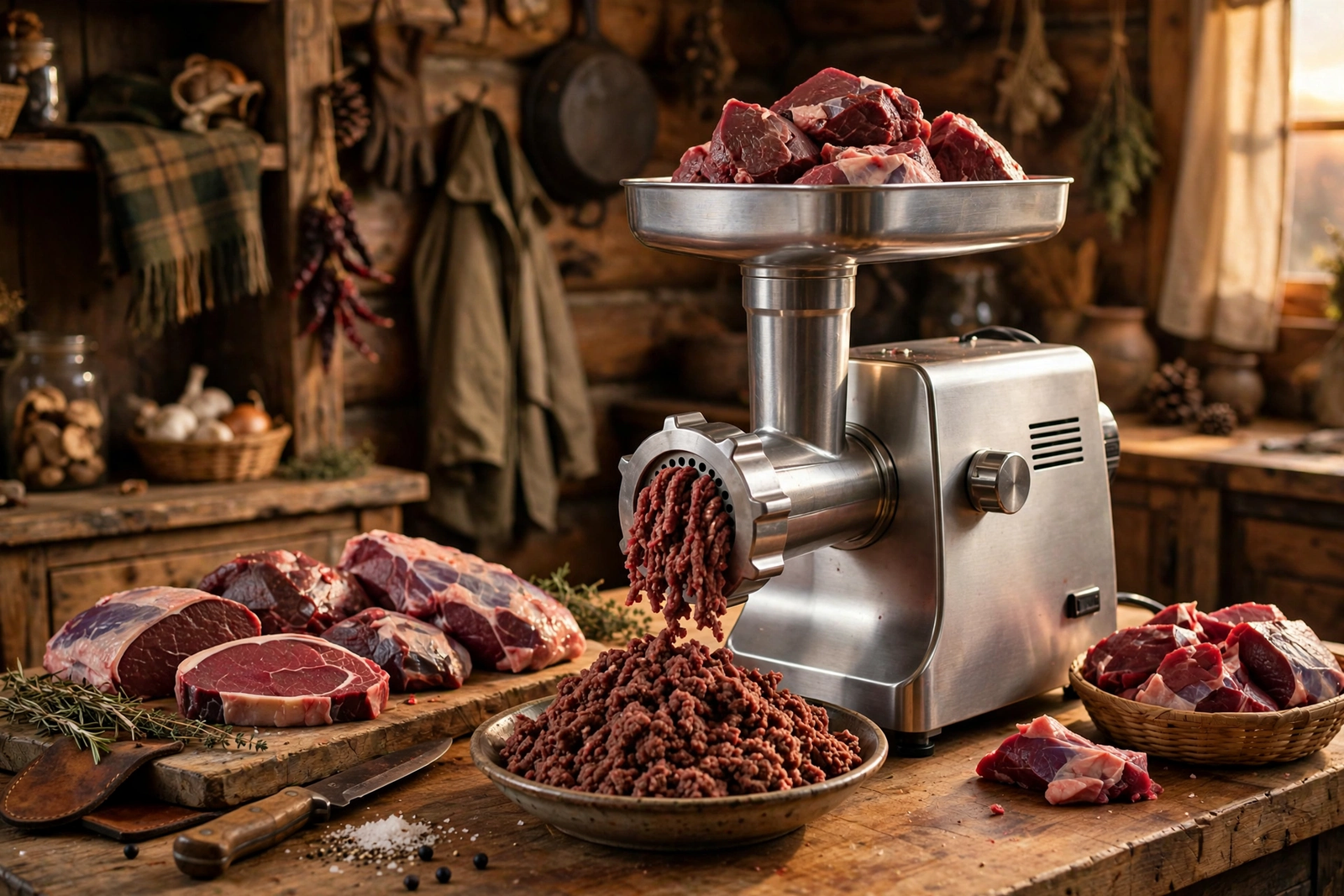
3 STX Turboforce II 4000
#12 Step-UpSame #12 head size as the 3000, built for a different job: long sessions. The Quad Air Induction Cooling is the headline feature, and it exists because hunters processing a deer run a grinder for an hour straight, which is exactly when ordinary motors overheat and die. Owners report the 4000 stays cool through sessions that would sideline lesser machines.
The other headline is bones. The Turboforce II is the rare home grinder STX actually rates for soft bones: chicken, rabbit, squirrel, quail. Not hard bones, not beef or pork leg bones, and never frozen, but for raw feeders making their own dog food, this is the feature that decides the purchase. Five plates and three blades give you more texture options than the 3000, and the foot pedal comes standard.
Who it is for: regular hunters processing multiple deer, raw feeders who need soft-bone capability, anyone whose sessions run long enough for motor heat to matter. Who should skip: casual grinders. If your sessions are under 20 minutes, the 3000 gives you the same #12 head for less.
| Head Size | #12 |
| Motor | 2000W max |
| Cooling | Patented Quad Air Induction Cooling |
| Throughput | 220 to 260 lbs/hour (some STX materials list 175 to 225) |
| Blades & Plates | 5 grinding plates + 3 blades |
| Attachments | Sausage stuffing attachments, foot pedal included |
| Bones | Soft bones only: chicken, rabbit, squirrel, quail. NOT hard bones, NOT frozen. |
| Warranty | 3 years |
- Air cooling for genuinely long sessions
- Rated for soft bones, rare at this size
- 5 plates for more texture options
- Foot pedal included
- Overkill for short casual sessions
- Still not for hard bones or frozen meat
- More machine than a #8 buyer needs
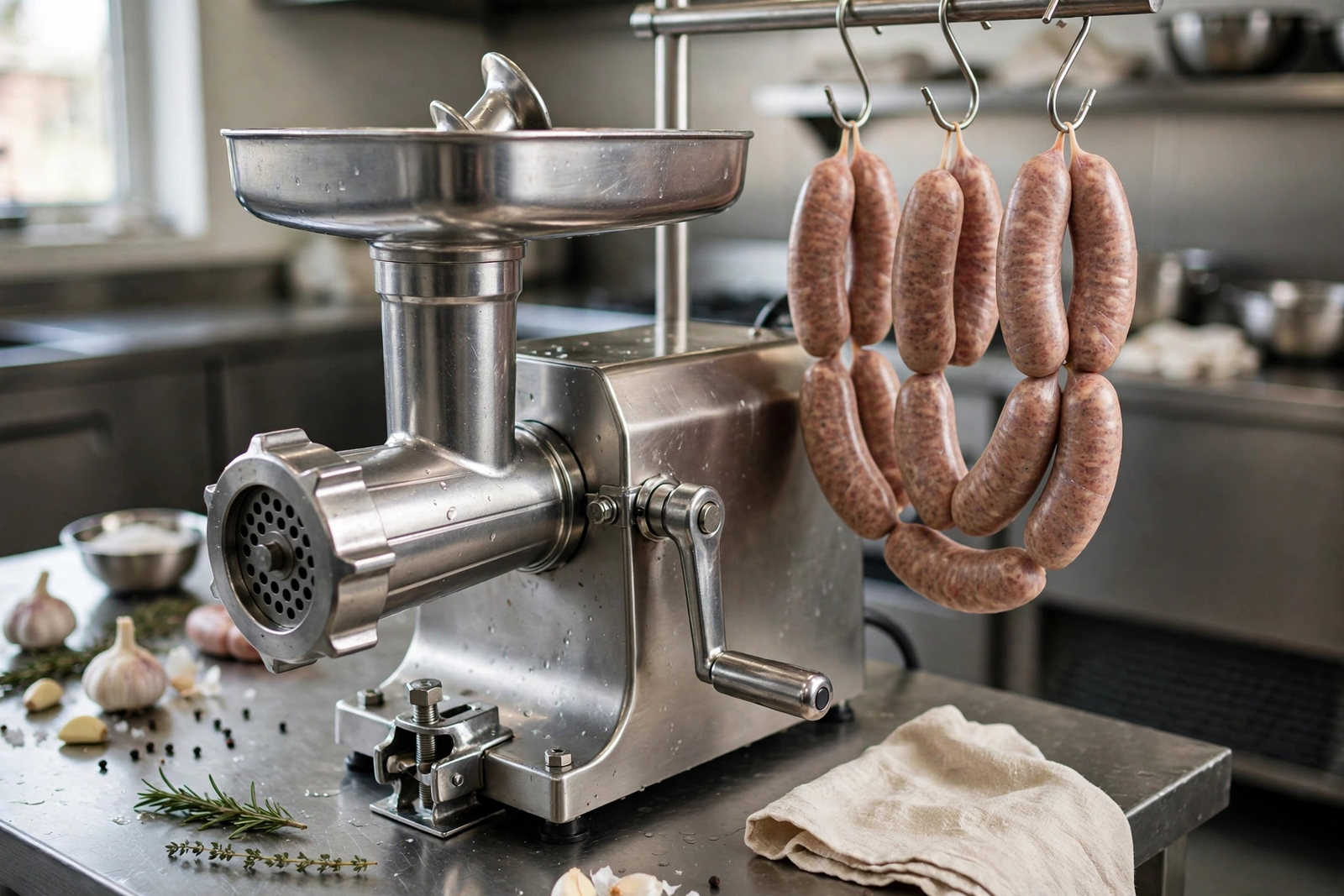
4 Weston Pro Series 1500W
The #22 BruiserThis is what a #22 feels like: 12 to 18 lbs per minute, a 3″ throat that takes big chunks, and a stainless steel body built for decades. One hunter’s report of grinding 25 lbs of venison in under 3 minutes came from a #22 in this class, and that number tells you everything about why deer processors buy them. A whole deer stops being an afternoon project and starts being a quick job.
Weston builds for the long haul in ways the spec sheet only hints at. The built-in knife sharpener keeps the blade biting instead of smearing, the offset head design feeds more naturally, and the 5-year warranty is the longest in this guide. The honest costs: it is heavy, it is loud compared to a #8, it retains more meat per batch (the waste math from earlier), and it costs multiples of the smaller machines. Treat it as meat-only in our book: Weston does not market it for bones.
Who it is for: serious hunters, bulk beef buyers, sausage-making days with 20+ lbs on the table. Buy-it-for-decades buyers. Who should skip: anyone grinding under 10 lbs per session. The waste penalty and the price both argue for a #12 instead.
| Head Size | #22 |
| Motor | 1500 watts / 2 HP, commercial-grade |
| Throughput | 12 to 18 lbs per minute (240 to 360+ lbs/hour) |
| Construction | Heavy-duty stainless steel |
| Features | Built-in knife sharpener, reverse, tray guard, offset head design |
| Attachments | Sausage stuffing kit included |
| Bones | Meat-only (not marketed for bones) |
| Warranty | 5 years (Pro Series line, per Weston) |
- Fastest throughput in this guide
- Commercial-grade stainless build
- Built-in knife sharpener
- 5-year warranty
- Heavy and loud next to a #8
- Most retained meat per batch
- Costs multiples of the smaller machines
5 LEM Big Bite Line
Hunter’s UpgradeLEM earns its own entry because it is the one brand that spans all three home sizes with the same philosophy: all-metal gears, heavy build, and a 5-year warranty that dwarfs the 1-year budget standard. Hunters on the forums are loyal to LEM for a reason, and “buy bigger than you think you need” is practically the brand’s unofficial slogan.
The honest tradeoffs: you pay for the build. These weigh 29 to 50 lbs depending on size, so they live on the counter or in the garage, not in a cabinet. The Big Bite #8 has no reverse function, which is a real omission at this price, so sinew jams mean disassembly. And the #12’s chicken-bone rating is useful for raw feeders but narrower than the STX II’s soft-bone rating. We could not verify a stable current listing to link, so compare the LEM against the STX and Weston picks above on your own terms.
Who it is for: buyers who want all-metal gears and a 5-year warranty, hunters who plan to own one grinder for a decade. Who should skip: anyone who needs reverse on every size, or who wants the lightest machine for the money.
| Big Bite #8 | 0.5 HP, ~7 lbs/min, ~29 lbs, all-metal gears, NO reverse |
| Big Bite #12 | 0.75 HP, ~11 lbs/min, ~33-38 lbs, handles chicken bones (per LEM) |
| Big Bite #22 | 1 HP, ~13 lbs/min, ~50 lbs |
| Warranty | 5 years across the line |
- All-metal gears across the line
- 5-year warranty, best in class
- One brand spanning #8, #12, and #22
- Heavy: 29 to 50 lbs depending on size
- Big Bite #8 has no reverse function
- No verified current listing to link
We could not verify a stable current listing for the LEM Big Bite line, so there is no buy button here. Search “LEM Big Bite meat grinder” on Amazon for the current listing.
Quick Comparison
| Product | Head Size | Throughput | Motor | Warranty | Standout |
| Sunmile SM-G73 | #8 | ~3 lbs/min | 1000W max (600W rated) | 1 year | Small batches, minimal waste |
| STX Turboforce 3000 | #12 | 180-240 lbs/hr | 3000W max (800-1200W load) | 3 years | The default #12 pick |
| STX Turboforce II 4000 | #12 | 220-260 lbs/hr | 2000W max | 3 years | Long sessions, soft bones |
| Weston Pro 1500W | #22 | 12-18 lbs/min | 1500W / 2 HP | 5 years | Deer, bulk, decades of use |
| LEM Big Bite line | #8 / #12 / #22 | 7 / 11 / 13 lbs/min | 0.5 / 0.75 / 1 HP | 5 years | All-metal gears, hunter favorite |
Our Verdict
For most buyers, the answer is a #12, and the STX Turboforce 3000 is the one we would buy. The #12 head hits the sweet spot: fast enough for a deer, small enough that waste per batch stays reasonable, with a 3-year warranty and a bundle that covers sausage making too. Step up to the STX Turboforce II 4000 if you hunt regularly, run long sessions, or need soft-bone capability. Go #22 with the Weston Pro Series 1500W only if your batches are genuinely big, whole deer and bulk beef buys, because that is where the extra head earns its keep. And if you only ever grind a few pounds at a time, ignore all of this and get the Sunmile SM-G73 #8: it wastes the least per batch and costs the least to own.
Pingback: Meat Grinder Keeps Jamming? 7 Fixes That Work (2026)
Pingback: STX Turboforce vs Weston Meat Grinder (2026)