
The best telescope for a 10 year old makes one of the most exciting gifts you can buy a 10-year-old, and one of the most likely to end up in a closet. The story repeats in every astronomy forum: the box arrives, the first night turns into a battle with a wobbly mount and a finder that shows nothing, and by week three the scope is a coat rack. That outcome has almost nothing to do with the child and almost everything to do with the telescope.
Kids give up on telescopes for three specific reasons. First, the setup is fiddly, so the first observing session starts 45 minutes after the excitement peaked. Second, the child cannot actually find anything in the sky, so the reward never arrives and boredom sets in. Third, the scope is too fragile or too heavy to carry outside without an adult on standby, which means it only gets used when a parent has spare energy. Every pick below is chosen to kill those three failure modes first and deliver impressive views second.
What keeps a 10-year-old interested is a fast first win: the Moon on night one, Jupiter’s moons on night two, Saturn’s rings after that. The four scopes below are picked for easy setup, forgiving mounts, and honest optics. Two are budget refractors, one is a guided scope that removes the finding problem, and one is a smart telescope for the kid who would rather photograph space than squint at it.
Nothing here comes from hands-on testing. Every claim is grounded in manufacturer spec sheets, reviewer findings, and owner reports.
- The Moon on night one is the goal. Pick a scope that gets there fast, not the one with the biggest box claims.
- Phone-guided finding, like Celestron’s StarSense, removes the number one reason kids quit: never finding anything.
- Cheap equatorial mounts are the top dust-collector cause. A simple up-down, left-right alt-az mount wins for kids.
- Ignore magnification claims like 600x. At 36x to 90x with the included eyepieces, these scopes show plenty.
- 70mm to 80mm aperture is the sweet spot: enough light for the Moon and planets, light enough for a kid to carry.
Best Telescope for a 10 Year Old: Top Picks at a Glance
Celestron StarSense Explorer LT 80AZ
Best overall for kids. The phone-guided finding removes the biggest frustration.
Celestron AstroMaster 70AZ
Best budget. A simple, proven 70mm refractor that just works.
Gskyer 70mm AZ70400
Cheapest entry. Travel-friendly with a carry bag for trips and camping.
ZWO Seestar S30
Best for the techy kid. No eyepiece skills needed, instant shareable photos.
Detailed Reviews
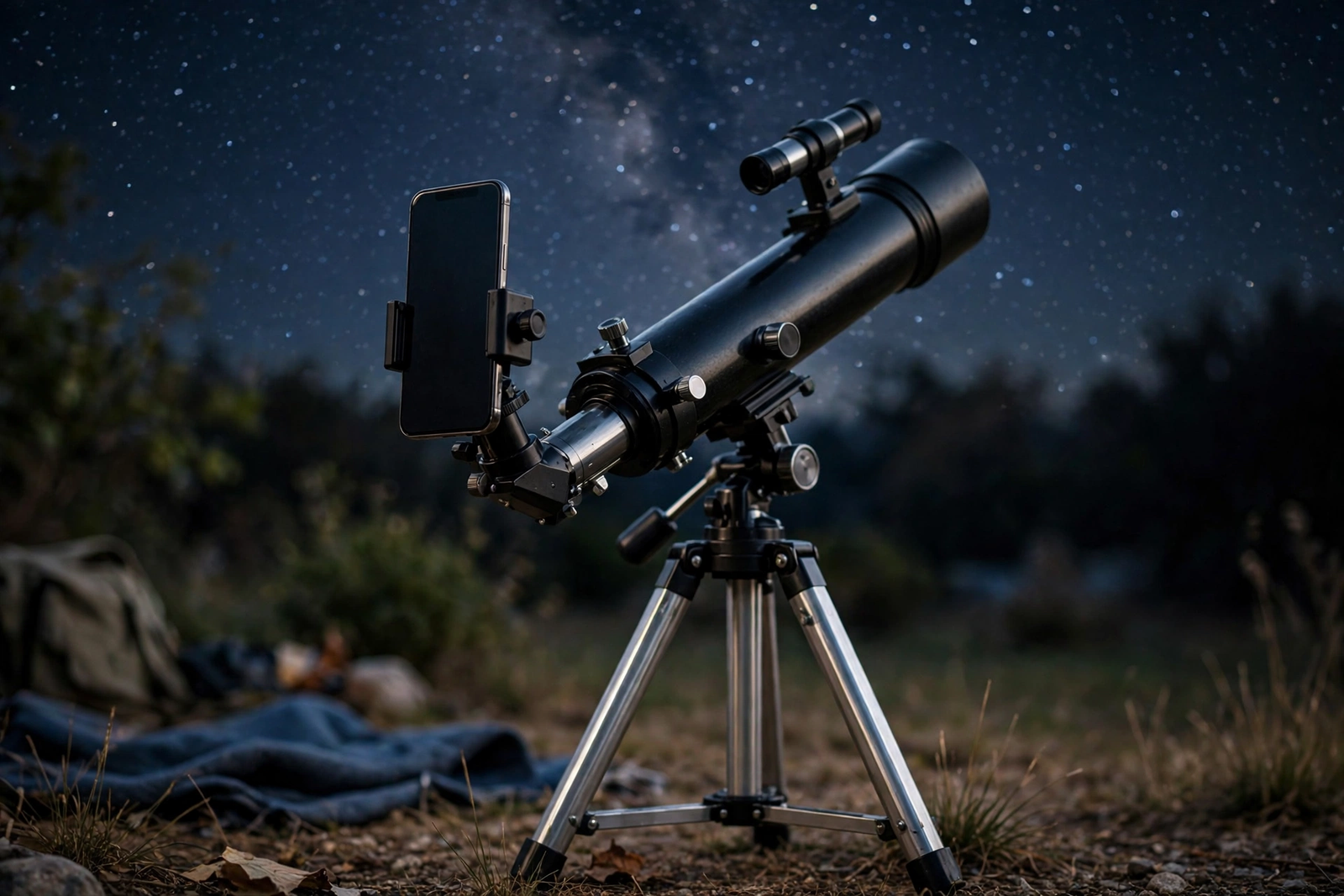
1 Celestron StarSense Explorer LT 80AZ
Best Overall for KidsThe reason most kid telescopes fail is not the optics. It is the finding. A child points the tube at the sky, sees nothing but black in the eyepiece, and concludes the telescope is broken. The StarSense Explorer LT 80AZ exists specifically to solve that problem, and it is the reason this scope tops the list.
Here is how it works. You dock your phone in the cradle on the mount, open the free StarSense app, and the phone’s camera reads the star pattern overhead. The app then shows you a live map of the sky with arrows guiding the tube: push left, tilt up, and a bullseye appears when you are on target. Owners report that kids who could not find the Moon with a regular finder were centering Jupiter by the second night with the arrows. The scope still moves by hand, so the child keeps the physical feel of aiming a real telescope, but the phone does the part that used to require star charts and patience.
Optically, you get an honest 80mm refractor with a long 900mm focal length, which keeps views sharp and mostly free of the color fringing that plagues cheap short refractors. The 25mm eyepiece gives 36x for wide Moon views, the 10mm gives 90x for craters and Jupiter’s cloud belts, and a 2x Barlow is in the box for experimenting. The mount is a simple manual alt-az: push the tube where the arrows say, no knobs, no counterweights.
Who it is for: The kid who will lose interest the moment finding targets gets hard, which is most 10-year-olds. Also the parent who wants observing to happen without becoming the unpaid telescope technician every clear night. Who should skip it: If your kid does not have access to a reasonably modern smartphone, the StarSense magic disappears and you are left with a plain manual 80mm scope. In that case the AstroMaster below saves you money.
| Aperture | 80mm refractor |
| Focal length / ratio | 900mm, f/11 |
| Eyepieces included | 25mm (36x) and 10mm (90x), plus 2x Barlow |
| Finder | StarPointer red-dot finder plus StarSense phone dock and app |
| Mount | Manual alt-azimuth |
| Warranty | 2-year |
| Price tier | Mid-$200s tier |
- Phone-guided finding removes the biggest frustration for kids
- sharp 80mm f/11 optics
- simple manual mount a child can operate
- 2-year warranty
- Needs a compatible smartphone to enable the headline feature
- still a manual scope, so no automatic tracking
- a bit longer tube than the ultra-portable options
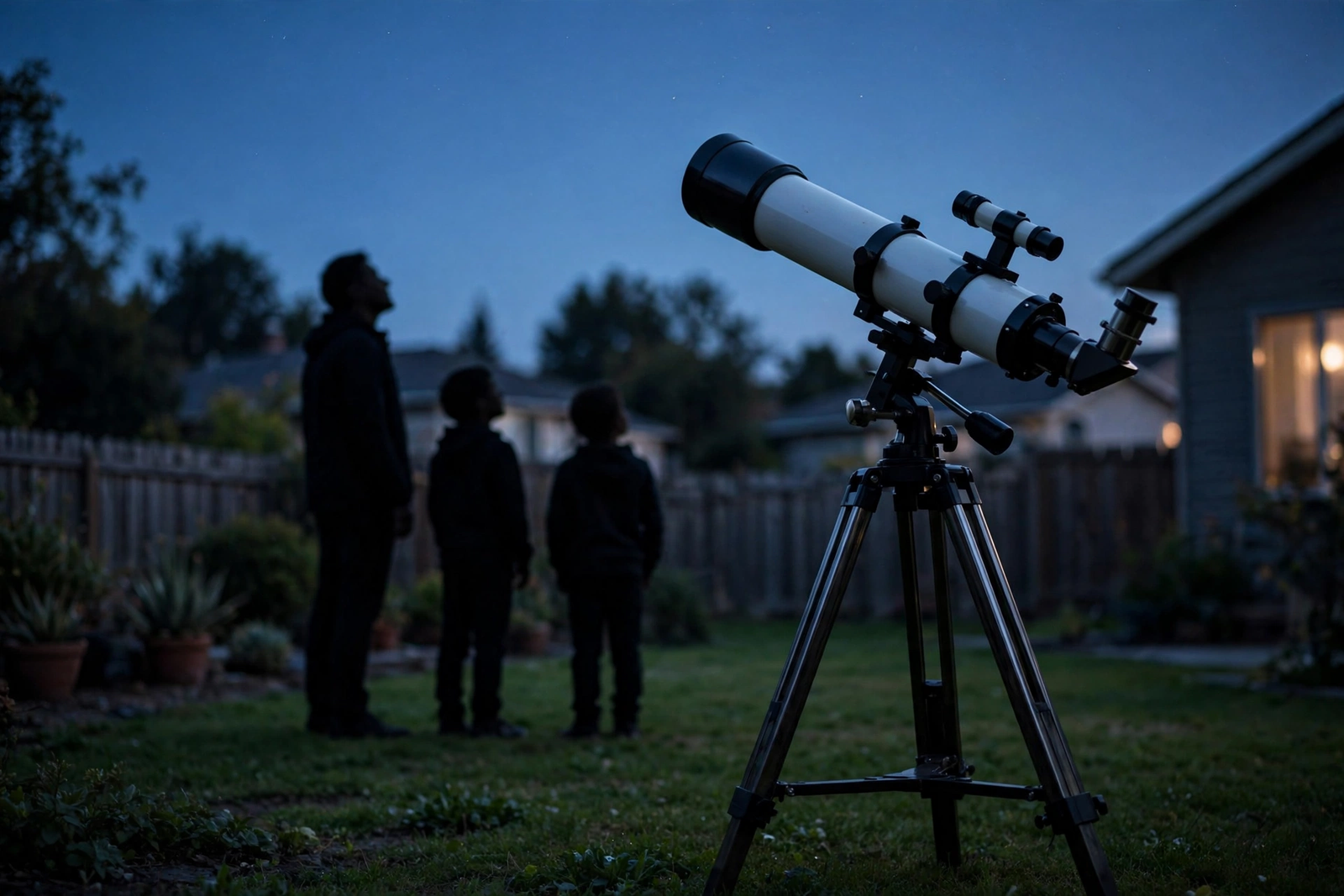
2 Celestron AstroMaster 70AZ
Best BudgetBefore phone-guided scopes existed, the AstroMaster 70AZ was the default answer to “what telescope for my kid,” and it is still a strong budget pick. This is a classic long-tube 70mm refractor: 900mm of focal length in an f/13 design, which is about as forgiving as beginner optics get. Long focal ratios are kind to inexpensive lenses, so the Moon looks crisp and Jupiter shows clean disks with its moons in a row.
The whole package is built around simplicity. The alt-az mount moves intuitively, the StarPointer red-dot finder beats tiny magnifying finders for kids, and the erect-image diagonal shows everything right-side up, so the scope doubles as a daytime bird watcher. A telescope that works at 3 PM gets used more than one that only works after bedtime. Owners describe it as the scope that “just works,” backed by a 2-year warranty.
The honest limitation is the finding problem this scope does not solve by itself. The Moon is easy, bright planets are findable with a free phone app, but fainter targets will frustrate a child working alone. Think of this as the pick for a parent who is willing to be the guide for the first few sessions, or for a kid who already shows patience with fiddly hobbies.
Who it is for: The budget-conscious parent who wants a proven, no-surprises first telescope, and families who like the idea of daytime nature watching as a bonus. Who should skip it: If your child gives up fast when things get hard, the unguided finding will likely end the hobby in a week. Spend the extra for the StarSense model above.
| Aperture | 70mm refractor |
| Focal length / ratio | 900mm, f/13 |
| Eyepieces included | 20mm (45x) and 10mm (90x) |
| Finder | StarPointer red-dot finder |
| Diagonal | Erect-image 90-degree, correct image orientation |
| Mount | Manual alt-azimuth |
| Warranty | 2-year |
| Price tier | Budget tier, commonly around $150 |
- Proven beginner design with crisp long-focus optics
- red-dot finder is kid-friendly
- works for daytime viewing too
- strong value at the budget tier
- No guided finding, so locating targets takes patience
- 70mm shows less than 80mm on faint objects
- basic mount, no slow-motion on both axes like pricier models
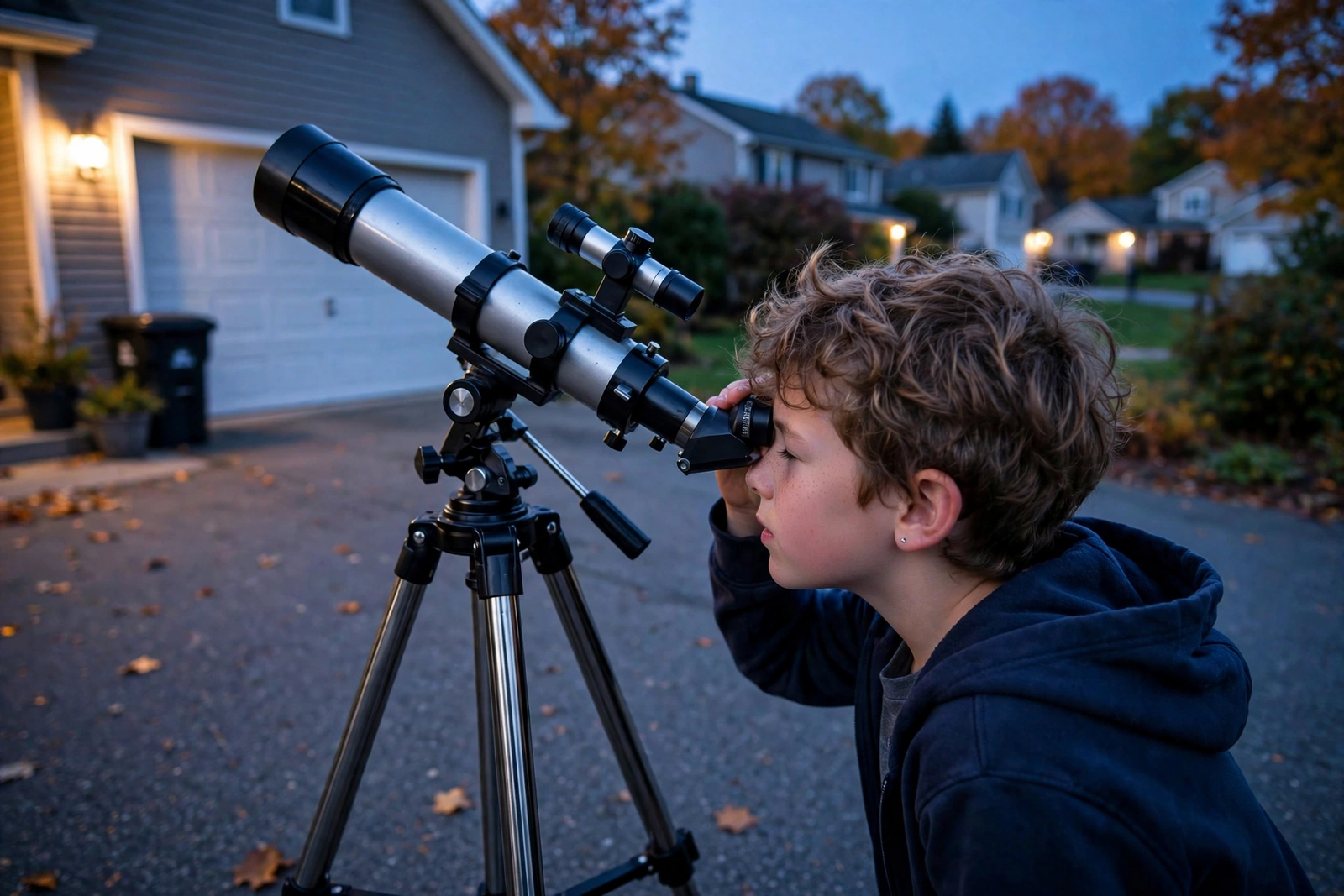
3 Gskyer 70mm AZ70400
Cheapest EntryIf the budget is tight or you want a telescope that can survive being tossed in the car for camping trips, the Gskyer 70mm AZ70400 is the cheapest credible entry point. The short 400mm tube keeps the whole package light at around 5.7 pounds, and it comes with a carry bag, which is rare at this price and genuinely useful: a telescope that travels gets used under dark skies instead of gathering dust at home.
The kit is generous: 25mm and 10mm eyepieces (16x and 40x), a 3x Barlow, a 5×24 finder, plus a phone adapter and wireless remote for Moon photos through the eyepiece. A 10-year-old who photographs craters on night one has a trophy to show at school, and that social proof fuels night two. Owners confirm the Moon looks great and Jupiter’s moons are visible.
Now the honesty, because a scope this cheap always has trade-offs. Owners report that the finder scope needs fiddling to align properly, so budget 15 minutes of daylight alignment before the first night. The best views come at 40x to 60x despite the much higher maximum magnification printed on the box; pushing past that just makes everything blurry. And the short f/5.7 refractor design shows some color fringing around bright objects like the Moon’s edge. None of this ruins the experience at this price, but go in with eyes open.
Who it is for: Grandparents and relatives shopping on a budget, families who want a travel scope for camping, and anyone testing whether the kid actually likes astronomy before spending more. Who should skip it: If you can stretch to the AstroMaster, its longer optics give cleaner views. If the child is the impatient type, the finder fiddling on night one could sour the experience.
| Aperture | 70mm refractor |
| Focal length / ratio | 400mm, f/5.7 |
| Eyepieces included | 25mm (16x) and 10mm (40x), plus 3x Barlow |
| Finder | 5×24 finder scope |
| Extras | Phone adapter, wireless remote, carry bag |
| Mount | Manual alt-azimuth |
| Weight | About 5.7 lbs |
| Price tier | Around $110 tier |
- Lowest credible price for a real telescope
- carry bag and phone adapter included
- light and travel-friendly
- great Moon photos for kids to share
- Finder needs careful alignment
- best views at 40x to 60x despite higher claimed maximums
- some color fringing on bright targets
- basic mount
Editorial note: the Gskyer 80mm AZ80400 is the bigger sibling of this scope, with 80mm aperture, a 400mm tube, three eyepieces and the same phone adapter bundle per gskyer.com. Search “Gskyer 80mm AZ80400” on Amazon for the current listing.
Check the Current Price on Amazon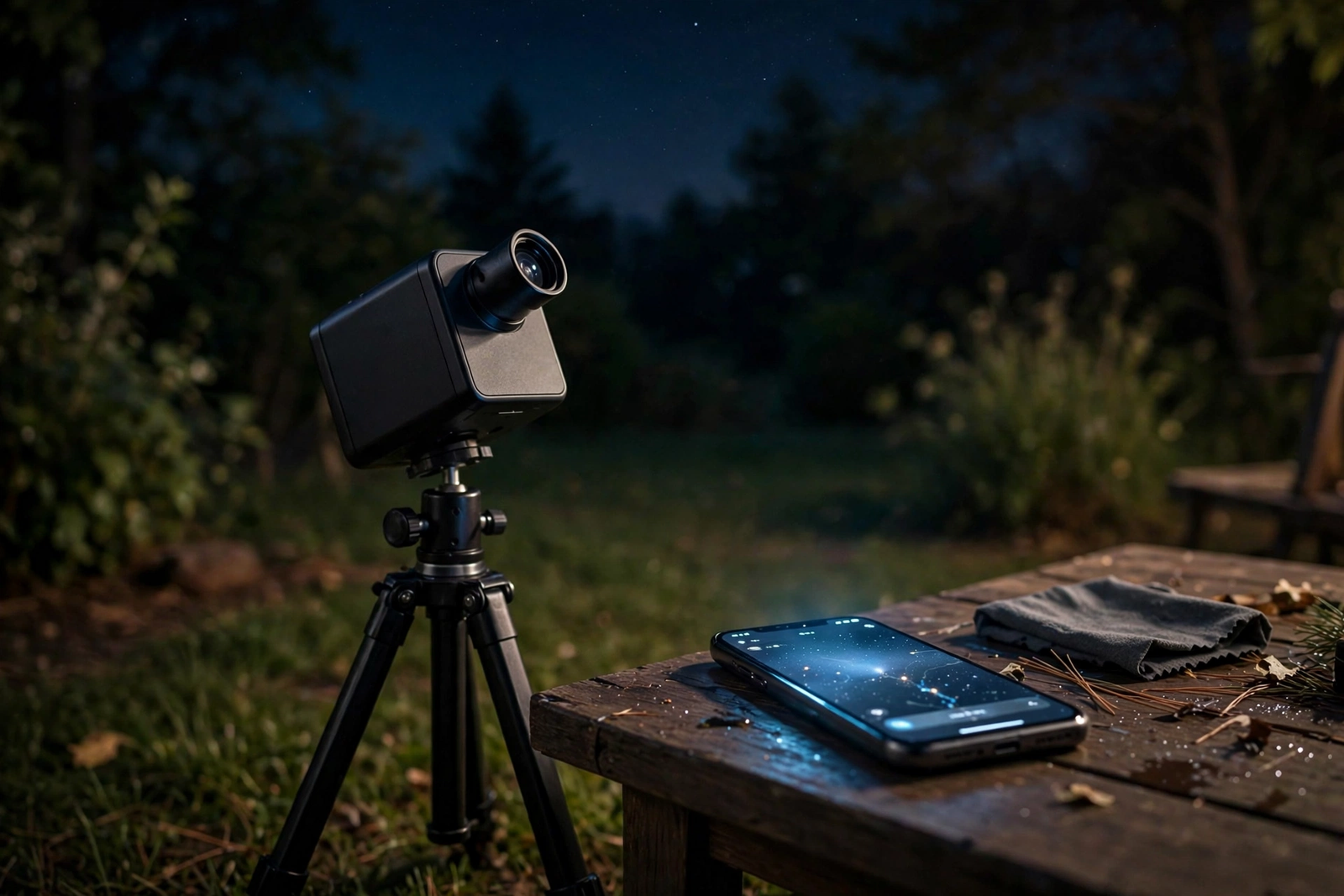
4 ZWO Seestar S30
Best for the Techy KidSome kids will never love the ritual of star-hopping with an eyepiece, and that is fine. The Seestar S30 is a smart telescope: a small, fully app-controlled instrument that aligns itself, finds targets on its own, and builds up a photograph of the object live on the phone or tablet screen by stacking short exposures. For a tech-native 10-year-old, this can be the most engaging option of all four.
The child picks the Orion Nebula in the app, the S30 slews to it, and within minutes a colorful image assembles on screen. Owners report kids staying out longer with smart scopes because every few minutes brings a new image to save and share. A dual-band filter helps it punch through city light pollution, and a solar filter enables safe daytime Sun viewing. At roughly the $300 to $400 tier, often $349 on sale, it costs more than the refractors, but it replaces the finder, the star charts, and the frustration.
Be honest with yourself about the trade-offs before buying. The 30mm aperture is not built for planets; Jupiter will be small and Saturn’s rings modest compared to what the 80mm refractor shows. The child looks at a screen, not through an eyepiece at real photons, and some parents feel that misses the point of a telescope. And it needs a charged phone or tablet and a charged scope battery, so there is a small ritual of charging before observing nights.
Who it is for: The kid who lives on screens, loves photography, or quit a traditional scope already. Also city families, since the live stacking handles light pollution far better than an eyepiece. Who should skip it: If you want your child to learn the constellations and experience light hitting their actual eye, buy one of the refractors above. If planets are the main interest, the bigger apertures win.
| Aperture | 30mm smart telescope |
| Control | Fully app-controlled GoTo with automatic alignment |
| Imaging | Live stacking, dual-band filter, solar filter included |
| Portability | Compact and lightweight, highly portable |
| Price tier | Roughly $300 to $400 tier, often $349 on sale |
- Finds targets itself, zero eyepiece skills needed
- instant shareable photos of nebulae and galaxies
- handles city light pollution well
- solar filter included
- 30mm aperture is not built for planets
- screen-based, not a traditional eyepiece experience
- needs charged devices
- costs more than beginner refractors
The First Night Game Plan
The telescope matters less than the first night. Follow this plan and the odds of a second night go way up.
1. Set up in daylight. Assemble in the afternoon and align the finder on a distant chimney or treetop while you can see. This single step prevents most first-night disasters.
2. Start with the Moon, lowest power first. Use the longest eyepiece in the box, usually the 25mm or 20mm. A wide view makes the Moon easy to find and shows the whole disk. Let the child do the aiming.
3. Then Jupiter. Even at 40x it is a bright disk with up to four moons in a line, like a tiny solar system. Kids love this because it looks alive, not like a picture.
4. One bonus target, then stop. If patience remains, try Saturn’s rings when visible, or the Orion Nebula as a glowing smudge. Frame it honestly: “that smudge is a cloud where stars are being born right now.” Context turns a smudge into a story.
5. Quit while it is fun. Thirty to forty-five minutes is plenty for night one. End on a high note. Night two: the Moon again at higher power, plus one new target the child picks.
What to Avoid for Kids
Cheap equatorial mounts. The number one telescope killer for children. Counterweights and setting circles turn a fun evening into an engineering project. A simple alt-azimuth mount is all a 10-year-old needs.
Absurd magnification claims. Boxes shouting 600x or 675x are selling fantasy. A 70mm telescope tops out around 140x on a perfect night, and the useful range for a kid is 40x to 90x. Judge a scope by its aperture and included eyepieces, not the big number on the box.
Toy telescopes. Tiny plastic scopes with wobbly tripods and unalignable finders teach kids that telescopes do not work, the opposite of the lesson you want.
Scopes too heavy to carry. If a 10-year-old cannot carry the telescope outside and set it up, every session depends on an adult’s energy level. Light and simple beats big and impressive for this age.
Buying aperture your kid cannot use. A large reflector shows more, but it also needs collimation, cooldown time, and muscle. Match the scope to the child’s patience, not to your ambitions for the child.
Our Verdict
Match the telescope to the kid. If your 10-year-old frustrates easily, the StarSense Explorer LT 80AZ is worth the extra money, because guided finding is the difference between a hobby and a closet ornament. If budget rules, the AstroMaster 70AZ is the proven classic. If you want the cheapest credible gift or a camping scope, the Gskyer 70mm AZ70400 gets it done. And if your kid would rather photograph the universe than squint at it, the Seestar S30 keeps them outside longest. Run the first-night game plan, and the scope stands a real chance of surviving past week three.