
KitchenAid meat grinder attachment vs standalone? If you own a KitchenAid stand mixer, this question finds you sooner or later. The grinder attachment sits there on Amazon for a fraction of the cost of a standalone grinder, and it is tempting to think the decision is obvious. Owners who have tried both will tell you it is not. This is a real tradeoff, and the right answer depends almost entirely on one number: how many pounds you grind per session.
Here is the short version before we get into the rounds. If you grind 5 pounds or less per session, the KitchenAid metal attachment wins. It is cheaper, it stores in a drawer, and it does the job. If you grind more than that, especially regularly, a standalone grinder wins by a wide margin. More power, faster throughput, less babysitting, and no risk to your mixer. The forums are full of people who started with the attachment, outgrew it, and bought the standalone. Almost nobody goes the other direction.
Below, we run the head-to-head across five rounds: batch size, speed, grind quality, cleanup and storage, and price. Then we review the actual products: the KitchenAid KSMMGA metal attachment plus four standalone grinders at different budgets, including one mentioned without a link because we could not verify its listing.
- The 5-pound rule: 5 lbs or less per session, the KitchenAid attachment wins. More than that, buy a standalone.
- Attachments are slow. A KitchenAid runs the grinder at Speed 4. Standalones in the 1000-3000W class move meat several times faster.
- Heat is the attachment’s weakness. Long sessions warm the meat, and warm meat smears. Standalones finish before that becomes a problem.
- Your mixer is at risk. Owners report stripped gears and burned-out KitchenAids from heavy grinding sessions. A standalone keeps the wear off a $300+ mixer.
- Best standalone value: the STX Turboforce 3000 for serious batches, or the Sunmile SM-G73 if your budget is tight.
KitchenAid Meat Grinder Attachment vs Standalone: The Head-to-Head
Round 1: Batch Size and Capacity
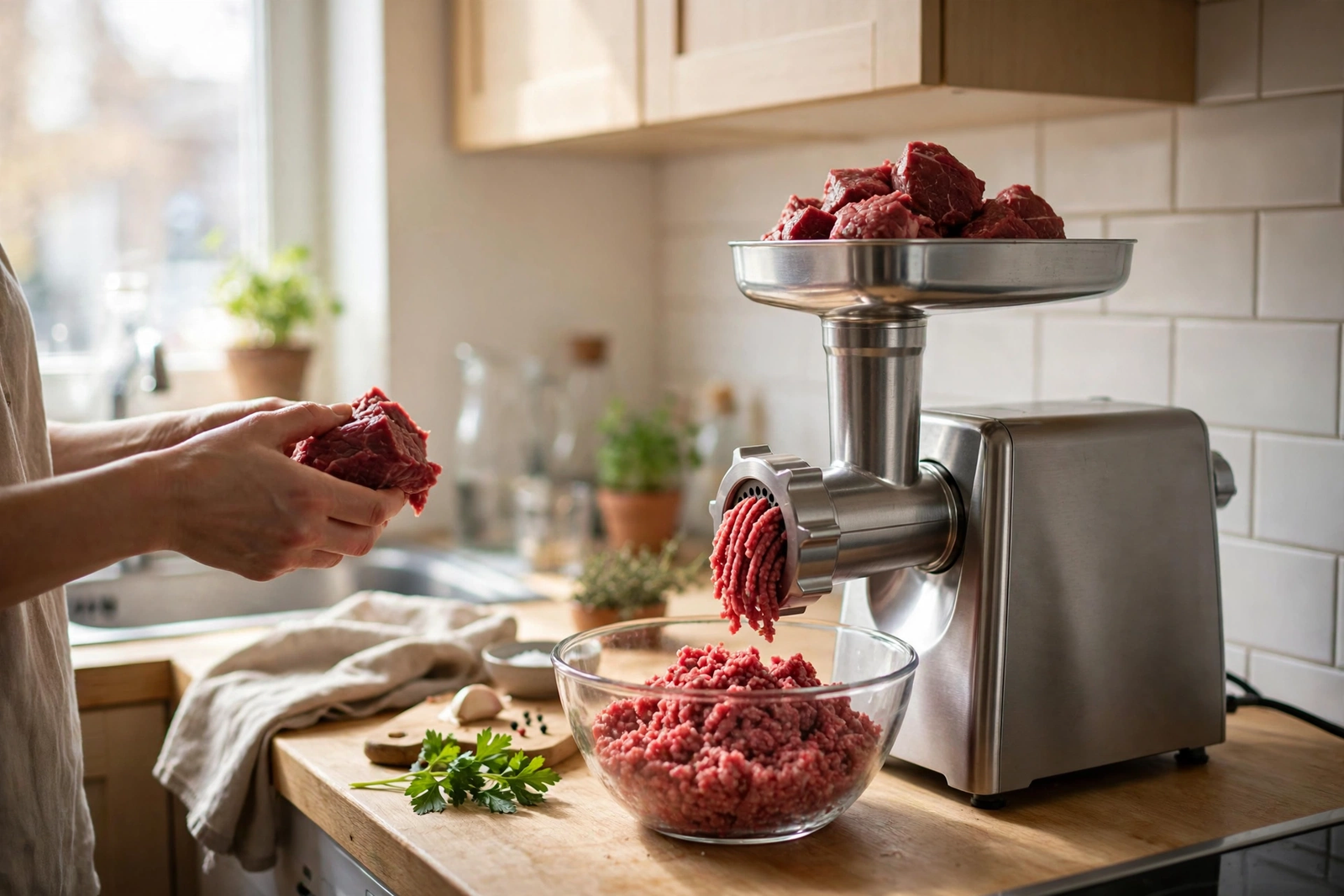
This is the round that decides everything. The KitchenAid attachment is a small grinder by design. It bolts onto the mixer’s power hub, and the mixer drives it at Speed 4. It handles a few pounds of burger meat or a small sausage batch perfectly well. Owners consistently report that 5 pounds is the comfortable ceiling. Push past it and the session gets long, the meat warms up, and the mixer works hard.
A standalone grinder does not have this ceiling. The STX Turboforce 3000 moves 180 to 240 pounds per hour through a #12 head. The Sunmile SM-G73, the budget pick here, still manages about 185 pounds per hour. Even the little Gourmia GMG525 will outpace the attachment. When hunters talk about grinding a whole deer, nobody is doing it with a KitchenAid attachment. The batch size alone disqualifies it.
Winner: standalone, and it is not close for anything over 5 pounds.
Round 2: Speed
Speed follows from capacity. The KitchenAid attachment grinds slowly because the mixer is not a grinder motor. It is a general-purpose motor running through the power hub at modest speed. A 5-pound batch takes a meaningful chunk of time, and a 10-pound batch turns into a project.
Standalones are built for one job. Their motors, from the Gourmia’s 500W rated up to the STX’s 3000W max, drive a purpose-built auger at full tilt. What takes the attachment the better part of an afternoon, a standalone does in minutes. Speed matters beyond convenience, too. Faster grinding means the meat stays colder, and cold meat grinds cleaner. The attachment’s slowness actively works against grind quality on bigger batches.
Winner: standalone, by a wide margin.
Round 3: Grind Quality
On small, cold batches, the attachment holds its own. The KSMMGA’s all-metal housing and three stainless plates (fine 3mm, medium 4.5mm, coarse 8mm) produce a clean grind, and the parts can be pre-chilled in the fridge or freezer, which owners say makes a real difference. For a few pounds of burger meat, the result is genuinely good.
The problem is consistency across a session. As the attachment run goes longer, the mixer motor warms, the housing warms, and the meat warms. Warm meat smears instead of cutting cleanly. Standalones finish batches fast enough that temperature never becomes an issue, and their larger heads and stronger motors cut more aggressively. For sausage, where texture matters, the standalone’s cleaner cut is noticeable.
Winner: tie on small cold batches. Standalone for anything bigger or longer.
Round 4: Cleanup and Storage
Here the attachment fights back. The KSMMGA breaks down into a handful of small parts that fit in its own storage case, and the whole thing lives in a drawer. Cleanup is quick because there is not much to clean. If you grind occasionally, this is a genuine quality-of-life advantage.
A standalone grinder is a countertop appliance. The STX models weigh about 12 pounds and need cabinet or counter space. More parts, more surface area, more cleanup. That said, none of it is difficult, and the parts are straightforward to wash. The storage cost is real but one-time. You find a spot and it lives there.
Winner: KitchenAid attachment, clearly. Small, self-contained, and easy to put away.
Round 5: Price and Value
The attachment is the cheapest way in. It costs a fraction of a standalone grinder, and if you already own the mixer, the total outlay is small. For someone who grinds a few pounds of burger a month, it is excellent value.
But value depends on the job. If you outgrow the attachment, you buy the standalone anyway, and now you have paid twice. Worse, heavy grinding sessions can damage the mixer itself. Forum threads include owners who stripped the mixer’s gears or burned out the motor grinding meat, turning a cheap attachment into a very expensive repair. A standalone keeps all the wear on a machine built for it.
Winner: attachment for light use. Standalone for anyone who will grind regularly or in volume.
Top Picks at a Glance
KitchenAid KSMMGA
All-metal attachment, pre-chillable parts, storage case. The one you already half-own.
STX Turboforce 3000
#12 head, 180-240 lbs per hour, full kit. The machine hunters buy after the attachment era.
Sunmile SM-G73
Sub-$100, about 185 lbs per hour, reverse switch. Real standalone power on a budget.
Gourmia GMG525
The cheapest way to try standalone grinding, with a recipe book for first-timers.
LEM Big Bite #8
All-metal gears, 5-year warranty, the hunter forum favorite. No verified link, search Amazon directly.
Detailed Reviews

1 KitchenAid KSMMGA Metal Food Grinder Attachment
Best for Small BatchesThis is the attachment to buy if you are going the attachment route. The older plastic KSMFGA model is cheaper, but the metal KSMMGA is the one owners recommend: sturdier housing, better grind consistency, and the parts can go straight in the freezer before a session. Pre-chilling is the single best thing you can do for grind quality, and this attachment is designed for it.
The honest assessment: within its limits, it is good. The three plates cover fine to coarse, the sausage tubes handle basic sausage making, and the storage case keeps everything together in a drawer. The limits are what the rounds above described. Five pounds is the comfortable zone. Beyond that you are asking a mixer to do a grinder’s job, and owners report the consequences: slow sessions, warming meat, and in the worst cases, damaged mixers. Respect the ceiling and it serves you well.
Who it is for: KitchenAid owners who grind 5 pounds or less per session, occasionally, and want the cheapest, most compact way to do it. Who should skip: anyone grinding regularly, anyone doing 10+ pound batches, hunters, and sausage makers doing volume. The standalone picks below are your answer.
| Housing | All-metal (aluminum) |
| Plates | 3 stainless: fine 3mm, medium 4.5mm, coarse 8mm |
| Included | 2 sausage stuffer tubes, larger food tray, storage case |
| Operation | Mixer power hub, Speed 4, pre-chillable parts |
| Weight | 2.5 lbs |
- Cheapest way in for KitchenAid owners
- Pre-chillable parts for cleaner grinds
- Stores in a drawer with its own case
- Good grind quality on small cold batches
- 5 lbs is the realistic ceiling
- Slow on bigger batches
- Heavy use risks damaging the mixer
2 STX Turboforce 3000
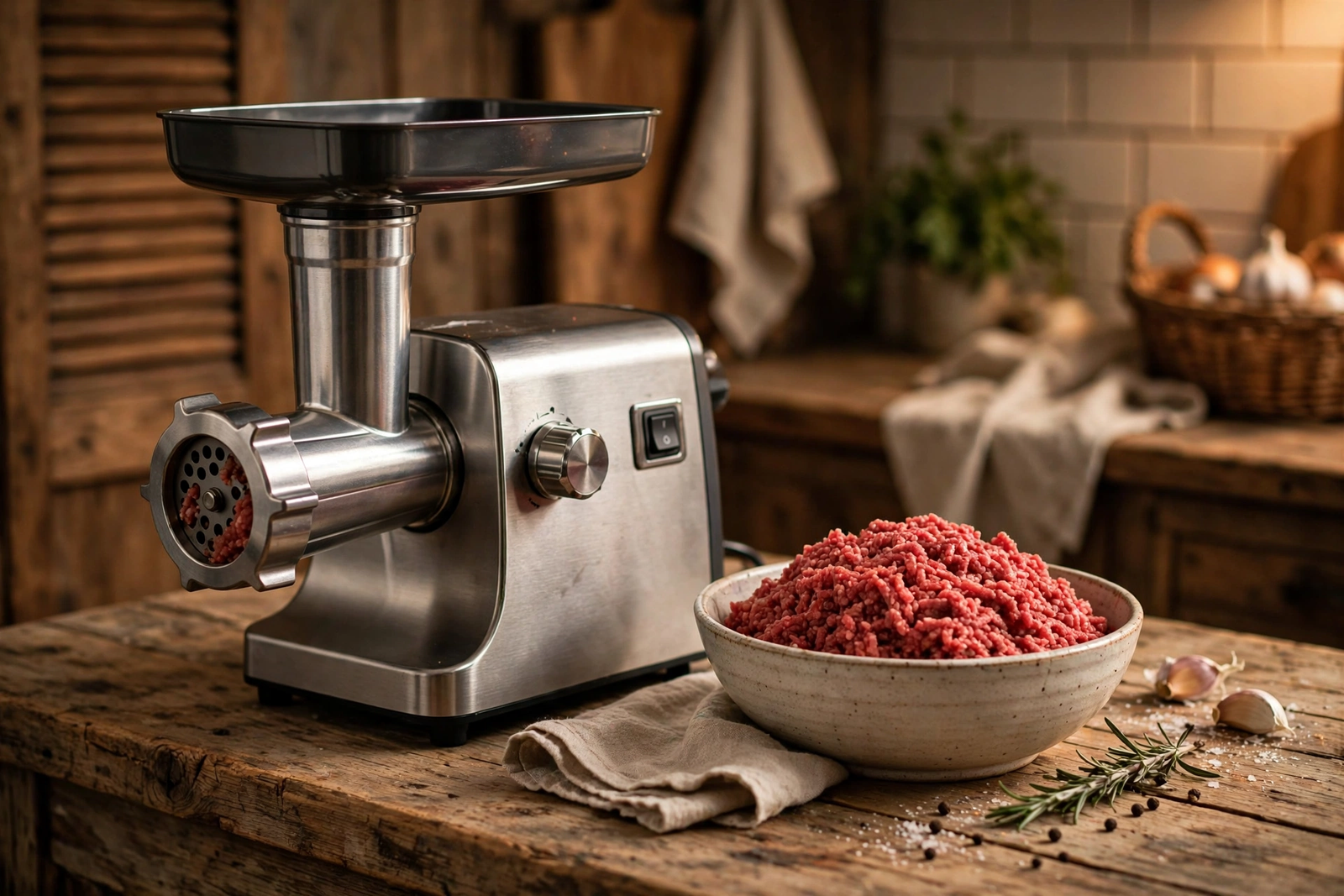
Best Standalone for Serious BatchesIf the attachment’s limits are your problem, this is the fix. The Turboforce 3000 has been a best-selling home grinder on Amazon for years, and it is the machine hunters reach for when the KitchenAid era ends. The #12 head and 180 to 240 pounds per hour throughput mean a batch that takes the attachment an afternoon takes this grinder minutes. Speed keeps the meat cold, cold meat grinds clean, and the whole session just works.
The Advanced Variable Intake is designed to pull meat through without the packing and stalling that cause jams, which matters because ex-attachment users are used to babysitting every ounce. The kit is complete: three blades, three plates, sausage tubes, kubbe maker, and a foot pedal on most bundles for hands-free operation. The hard limit, and it is worth repeating: STX says this machine will not grind bones. Meat only.
Who it is for: KitchenAid owners who outgrew the attachment, hunters, and anyone grinding 10+ pounds per session or processing deer. Who should skip: light, occasional grinders doing a couple of pounds. The attachment above is cheaper and stores smaller.
| Motor | 3000W max locked (800-1200W under load) |
| Head Size | #12 |
| Throughput | 180-240 lbs per hour |
| Included | 3 blades, 4/7/10mm plates, 3 sausage tubes, kubbe maker, foot pedal (most bundles) |
| Warranty | 3 years |
- Finishes in minutes what takes the attachment hours
- Advanced Variable Intake resists packing and jams
- Complete kit with foot pedal on most bundles
- Proven bestseller with a strong owner track record
- Will NOT grind bones, per STX
- Needs real counter or cabinet space
3 Sunmile SM-G73
Best Budget StandaloneThe Sunmile SM-G73 is the answer for the buyer who wants to escape the attachment but does not want to spend much doing it. It is a sub-$100 workhorse with thousands of Amazon ratings, and its throughput of about 185 pounds per hour dwarfs anything the KitchenAid attachment can do. The #8 head suits moderate batches well, and the smaller head wastes less meat per batch than a big #12, which is a genuine plus if you are grinding 5 to 10 pounds at a time.
The reverse switch is the feature that matters most in this comparison. Attachment users who have fought clogs by disassembling the head will appreciate clearing them with a switch. ETL certification adds reassurance at this price. Owners report it handles the standard burger and sausage routine reliably. It will not match the STX for speed or capacity, but it does not need to at this price.
Who it is for: budget buyers stepping up from the KitchenAid attachment, and anyone grinding moderate batches of burger and sausage. Who should skip: high-volume hunters processing whole deer. The #8 head is slow for that workload. Look at the STX above.
| Motor | 1000W max (600W rated) |
| Head Size | #8 |
| Throughput | About 185 lbs per hour |
| Controls | ON/OFF/REVERSE switch |
| Warranty | 1 year |
- Sub-$100 price
- Reverse switch for clearing clogs
- ETL certified
- Smaller head wastes less meat on small batches
- #8 head is slow for big batches
- Only 1-year warranty

4 Gourmia GMG525
Best Low-Risk StarterThe Gourmia GMG525 is the lowest-commitment standalone here. It is cheap enough to learn on, which is exactly how owners describe using it: a first grinder that teaches you the craft before you decide whether to invest more. The included recipe book is a nice touch for beginners who are grinding their first batches and want guidance.
The specs are modest, and you should read them that way. 500W rated with a 1000W max is enough for small to moderate batches, not for deer season. But it has the essentials: three plates, a reverse switch for clearing clogs, and ETL approval. For a KitchenAid owner who is unsure whether standalone grinding is even for them, this is the cheapest way to find out without risking the mixer.
Who it is for: first-timers and the curious, anyone who wants to try standalone grinding at the lowest possible cost. Who should skip: anyone who already knows they grind in volume. Buy the capability you need the first time.
| Motor | 500W rated (1000W max) |
| Plates | 3 stainless steel (fine, medium, coarse) |
| Included | Sausage horn, kubbe attachment, food pusher, recipe book |
| Controls | ON/OFF/REVERSE switch, ETL approved |
| Warranty | 1 year |
- Lowest cost way to try a standalone
- Reverse switch included
- Recipe book helps beginners
- ETL approved
- Modest power, not for big batches
- You may outgrow it quickly
5 LEM Big Bite #8
Buy-It-for-Years MentionThe LEM Big Bite #8 deserves a mention because it comes up constantly in hunter forums as the “buy it once” grinder. All-metal gears, a 5-year warranty, and a reputation for surviving years of deer seasons. Owners describe the step up from a KitchenAid attachment to a LEM as night and day. It is heavier and more expensive than the budget standalones here, but it is built for people who grind every season without thinking about it.
Two honest caveats. First, it has no reverse function, so clogs get cleared the manual way. Second, we could not verify a current Amazon listing for it, so there is no buy button below. If the LEM appeals to you, it is worth searching for directly.
Who it is for: hunters and serious home processors who want a grinder that lasts decades and do not mind paying for it. Who should skip: budget buyers and anyone who considers reverse non-negotiable.
| Motor | 0.5 HP |
| Head Size | #8 |
| Throughput | About 7 lbs per minute |
| Build | All-metal gears, about 29 lbs, no reverse function |
| Warranty | 5 years |
- All-metal gears built for decades
- 5-year warranty
- Hunter forum favorite
- No reverse function
- Heavier and pricier than budget picks
Search “LEM Big Bite #8” on Amazon for the current listing.
Comparison Table
| Product | Key Specs | Standout |
| KitchenAid KSMMGA | Attachment, mixer Speed 4, ~5 lbs/session ceiling | All-metal, pre-chillable, stores in a drawer |
| STX Turboforce 3000 | 3000W max, #12 head, 180-240 lbs/hr, 3-yr warranty | Bestselling standalone, full kit |
| Sunmile SM-G73 | 1000W max, #8 head, ~185 lbs/hr, 1-yr warranty | Budget pick, reverse, ETL certified |
| Gourmia GMG525 | 500W rated (1000W max), 3 plates, 1-yr warranty | Cheapest standalone, recipe book |
| LEM Big Bite #8 | 0.5 HP, #8 head, ~7 lbs/min, 5-yr warranty | All-metal gears (no verified link) |
Our Verdict
The 5-pound rule settles it. If you grind 5 pounds or less per session and you already own the mixer, buy the KitchenAid KSMMGA metal attachment. It is cheap, compact, pre-chillable, and genuinely good within its limits. But if you grind more than that, grind often, or have any hunting or bulk sausage plans, stop risking your mixer and buy a standalone. The STX Turboforce 3000 is the clear pick for serious batches: the #12 head, 180 to 240 pounds per hour, and the full attachment kit end the attachment era for good. On a tight budget, the Sunmile SM-G73 gets you real standalone performance with reverse for under a hundred dollars. Either way, the mixer goes back to making bread, which is what it was built for.