
What size portable power station do I need? Buying one is easy: pick a brand, click buy, and a box shows up. Buying the right size is where nearly everyone gets tripped up. Too small, and it dies on night one of the outage while your fridge slowly warms up. Too big, and you paid good money for a 60-lb box that lives in your garage taking up space and annoying your spouse.
Here is the good news: sizing a power station is just basic arithmetic, not electrical engineering. There are two numbers that matter, one formula worth memorizing, and a handful of traps that catch first-time buyers. Once you know them, you can size for a fridge, a CPAP machine, a weekend camping trip, or a whole outage plan in about five minutes.
This guide teaches you the sizing math in plain English, shows you a watt table for the appliances people actually run, walks through three worked examples, and then points you to the right capacity tier with real products worth buying in 2026. Do the math first, shop second. You will thank yourself during the next blackout.
- Watts = how much power you can run at once. Watt-hours = how much total energy is stored (how long it lasts).
- The runtime formula: (Wh x 0.85) / device watts = hours. The 0.85 accounts for conversion losses.
- Most people need 1000-1200Wh for real backup (fridge + devices). 250-500Wh covers devices, CPAP, and camping.
- Biggest mistakes: ignoring surge watts on fridges and motors, and treating advertised Wh as fully usable (it is not).
- Whole-home backup is a fantasy for portable units. That job needs a multi-kWh system, not one portable box.
What Size Portable Power Station Do I Need: Top Picks at a Glance
EcoFlow Delta 2
The safest single choice. 1024Wh, fast recharge, 5-year warranty.
Bluetti EB3A
268Wh at 10.1 lbs. Phones, laptops, and CPAP for minimal money.
Bluetti AC200L
2048Wh expandable to 8192Wh. A genuine home-backup machine.
Watts vs Watt-Hours, in Plain English
These two numbers are printed on every power station, and they answer two different questions.
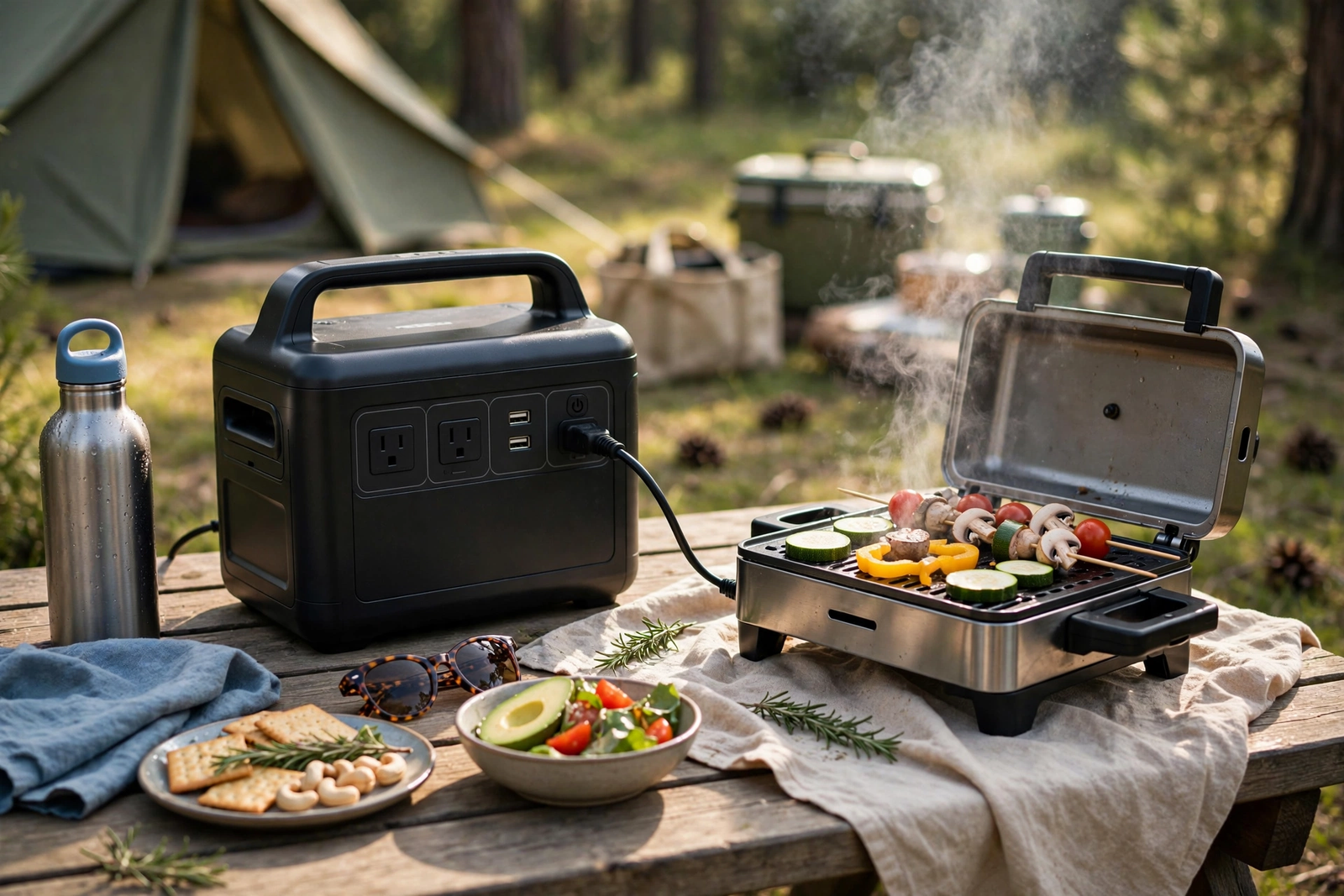
Watts (W) answers: “How much can I run at once?” A unit rated 1800W can power devices totaling up to 1800W at the same time. Run a 1000W microwave and a 600W appliance together, and you are at 1600W, within the limit. Plug in a 2000W space heater, and it overloads.
Watt-hours (Wh) answers: “How long will it last?” A 1000Wh battery can deliver 1000 watts for one hour, or 100 watts for ten hours. More Wh means more total energy, which means longer runtimes.
Think of it like a water tank. Watts are the width of the hose (how fast water flows out). Watt-hours are the size of the tank (how much water you have). You need both numbers to make sense. And here is the one formula worth memorizing:
Runtime (hours) = (rated Wh x 0.85) / device watts. The 0.85 accounts for the roughly 15 percent lost converting battery power to wall-style AC power. A 1000Wh unit gives you about 850 usable watt-hours, not 1000.
Appliance Watt Table
Use these typical values for planning. Actual devices vary, so check the label near your appliance’s plug if you want to be precise.
| Phone charging | 15W. Yes, for days |
| WiFi router | 10-15W. Yes, trivial |
| LED lamp | 10-20W. Yes |
| CPAP (no humidifier) | 30-60W. Yes, about 20 hours |
| CPAP (with humidifier) | 60-90W. Yes, about 10-13 hours |
| Laptop | 60W. Yes, about 14 hours |
| Mini fridge | 60W. Yes, about 14 hours |
| Full-size fridge | 100-150W. Yes, about 8-12 hours |
| Coffee maker | 800W. Briefly, about 1 hour |
| Microwave | 1000W. Briefly, under 1 hour |
| Space heater | 1500W. No, not practical |
| Electric stove | 2000W+. No |
The middle column shows typical watts; the note shows what a 1000Wh unit can do with it.
Worked Examples
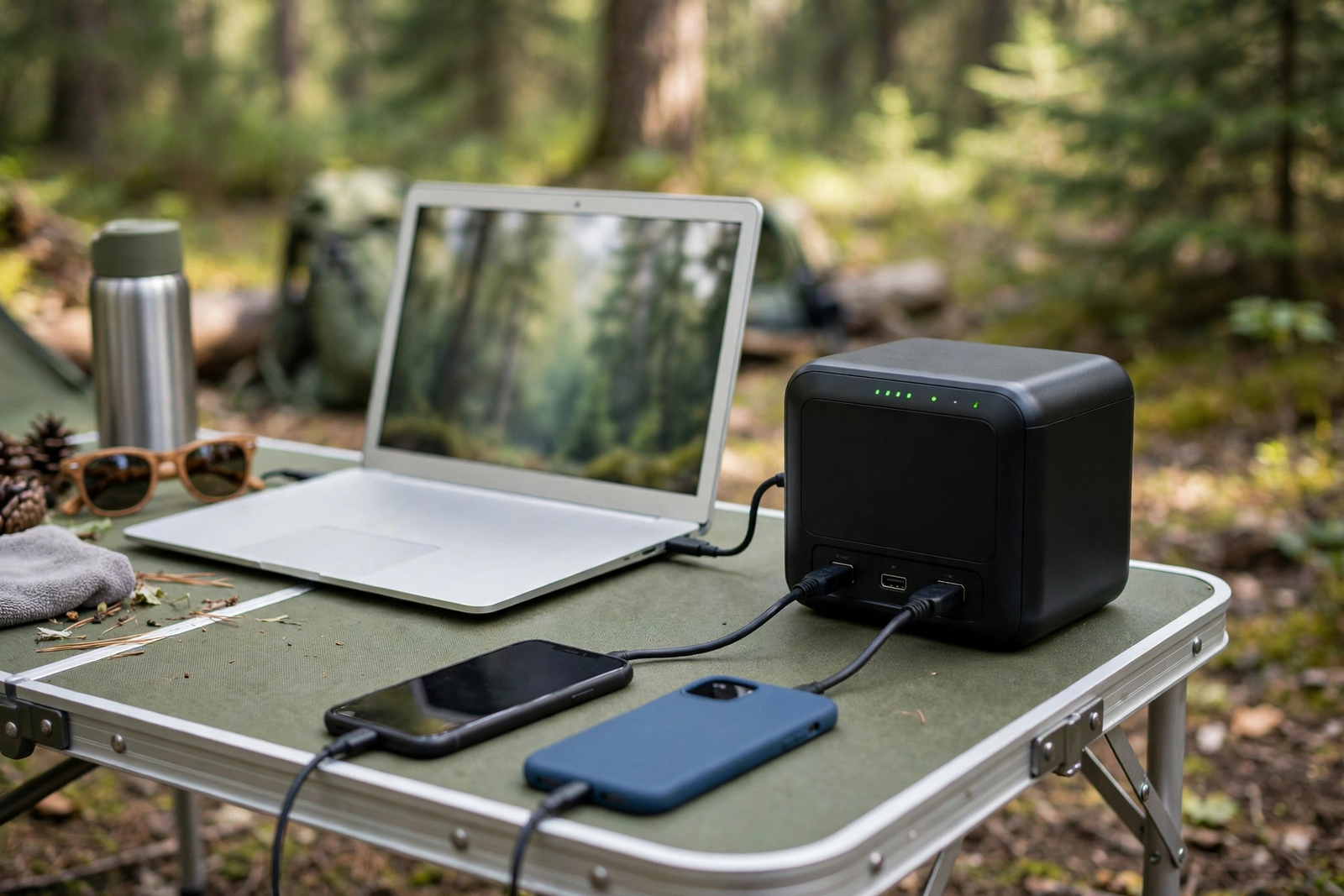
Weekend camping: phones for two people, a laptop for a few hours, string lights, and a small fan. Rough daily need is about 370Wh. For two days, that is around 740Wh usable, or roughly 870Wh rated. A 1000-1100Wh unit like the Jackery Explorer 1000 v2 handles it, and a small unit like the Bluetti EB3A works as a second battery for phones at the campsite.
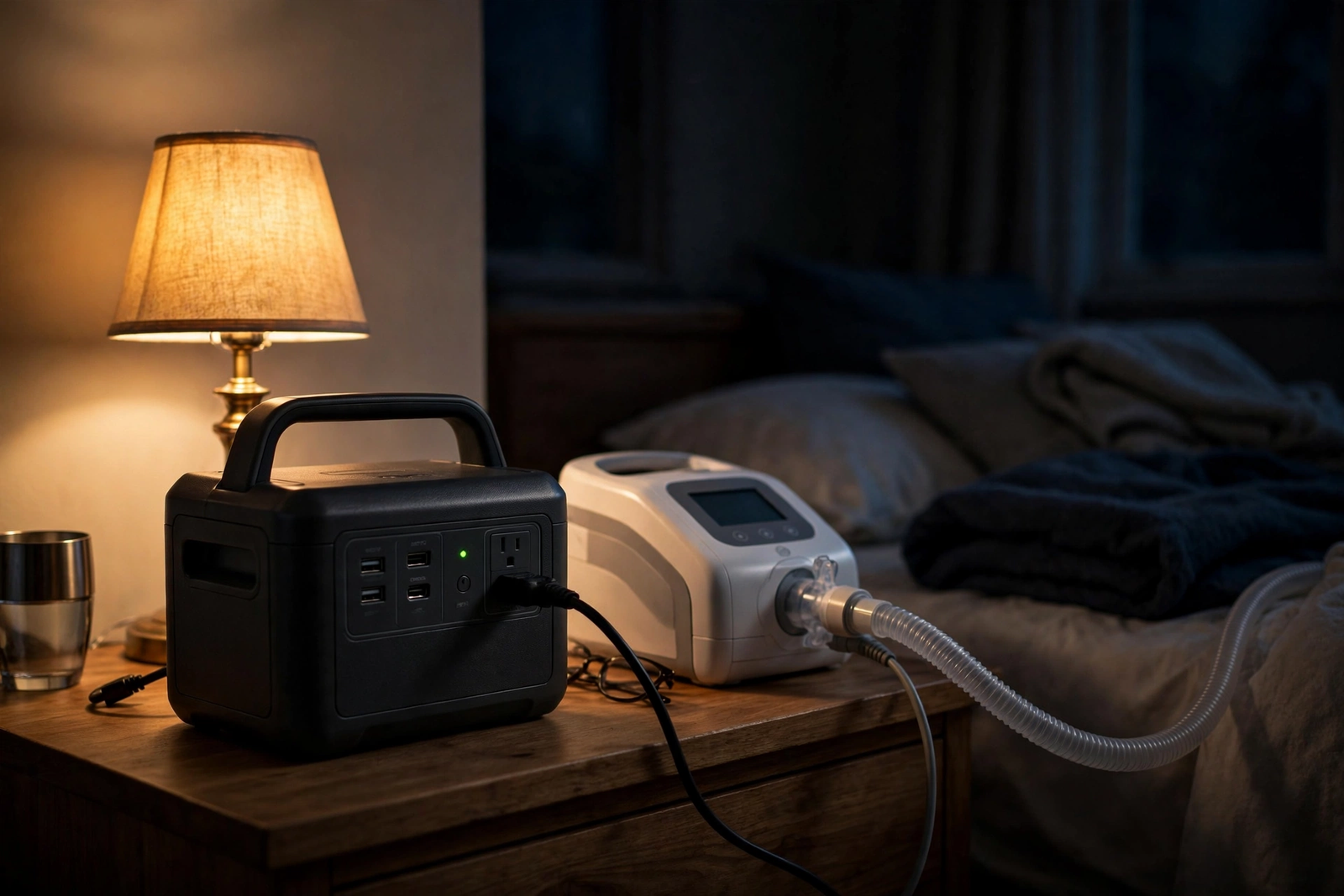
CPAP overnight: 8 hours at 40W without the humidifier is 320Wh of usable energy, or about 380Wh rated. The EcoFlow River 2 Max (512Wh) covers this with room to spare. With the humidifier and heated tube (70W average), you need about 660Wh rated, so step up to a 1000Wh-class unit like the Delta 2, which gives roughly 12 hours.
Fridge during an 8-hour outage: a full-size fridge averaging 130W over 8 hours needs 1040Wh usable, or about 1220Wh rated on paper. Real-world compressor cycling usually brings this down, and a 1024Wh unit like the EcoFlow Delta 2 covers an 8-hour outage with margin, often stretching to 10-12 hours. The Bluetti AC180 (1152Wh) gives extra cushion.
Common Sizing Mistakes
- Buying too small. The classic error: a 300Wh unit keeps the fridge alive for two hours. Size for your biggest essential load (usually the fridge), not your smallest.
- Ignoring surge watts. Fridges and anything with a motor draw 2-3x their rated watts for a split second at startup. Check the surge rating, not just the continuous rating.
- Treating advertised Wh as usable Wh. The box says 1024Wh; you get about 870Wh of usable AC power. Use the 0.85 multiplier in every calculation.
- Forgetting everything runs at once. Fridge (130W) plus CPAP (40W) plus laptop (60W) plus router (15W) is 245W total, not 130W. Add them up.
- Sizing for the dream instead of the need. “Maybe I will run the space heater” is how you end up buying a 2000Wh unit you can barely lift. Size for what you will actually plug in.
Detailed Reviews
Small (250-500Wh): Devices, CPAP, Camping
1 Bluetti EB3A
Best for: devices, CPAP, and camping on a budgetThe budget champ of the small tier. 268Wh, 10.1 lbs, 600W AC output (1200W surge). It covers phones, laptops, a router, LED lights, and a CPAP without the humidifier, all in a box that fits on a shelf. The 100W USB-C port charges laptops fast, and there is a 15W wireless charging pad on top.
Keep expectations honest: this tier will not carry a full-size fridge. It keeps your devices alive for days, which for many people is exactly the job they need done. It also makes an excellent second unit alongside a bigger station, handling phones and laptops while the big box runs the fridge.
| Capacity | 268Wh LiFePO4 |
| AC Output | 600W (1200W surge) |
| Weight | 10.1 lbs |
| Recharge | 0-80% in 30 min |
• Very affordable and ultra-portable
• 100W USB-C plus wireless pad
• Great as a second unit
• No fridge backup at this size
• CPAP humidifier needs a bigger unit
2 EcoFlow River 2 Max
Best for: grab-and-go backup with real capacityThe middleweight of the small tier. 512Wh, 500W AC output (1000W with X-Boost), only 13.4 lbs. That combination covers a CPAP all night, a laptop for a workday, a stack of devices, or a mini fridge (60W) for around 7 hours.
It charges fully in 60 minutes on AC, which makes it easy to keep topped up without planning ahead. This is the unit for someone who wants more than phone charging but does not need to run a full-size fridge. If the fridge is non-negotiable, step up to the medium tier instead.
| Capacity | 512Wh LiFePO4 |
| AC Output | 500W (1000W X-Boost) |
| Weight | 13.4 lbs |
| Recharge | 0-100% in 60 min (AC) |
• Covers CPAP, laptop, mini fridge
• Light at 13.4 lbs
• Full charge in 60 minutes
• Full-size fridge is out of reach
• 500W output limits larger loads
Medium (1000-1200Wh): The Real Backup Tier
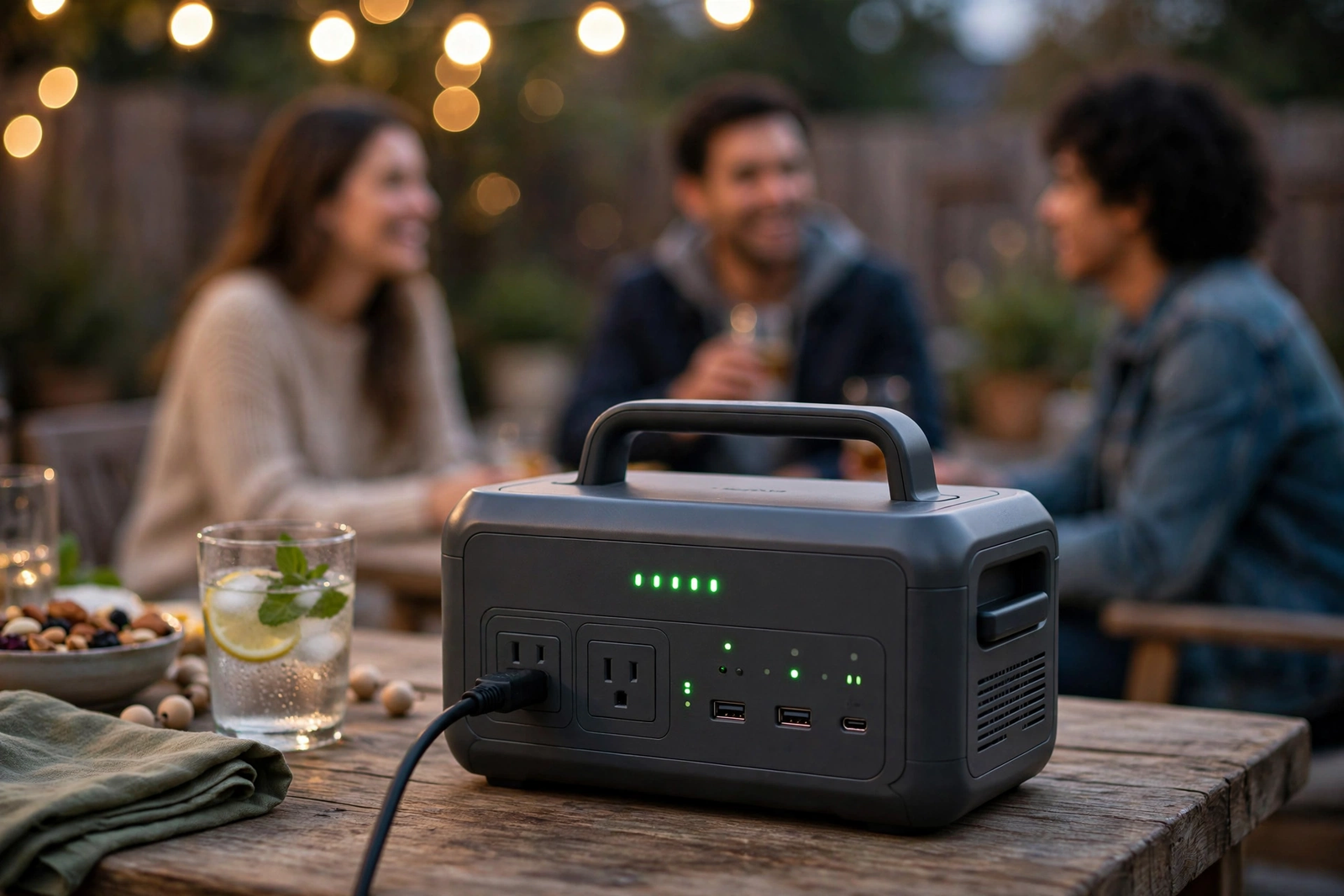
3 EcoFlow Delta 2
Best for: the safest single choice for most peopleThis is where most buyers should land, and the Delta 2 is the all-rounder of the tier. 1024Wh, 1800W AC output (2700W surge), 27 lbs. That covers a full-size fridge through a typical outage, plus CPAP, devices, and lights, with the surge headroom for fridge compressor startups.
Charging speed is the standout: 0 to 80 percent in 50 minutes from a wall outlet. During rolling outages or storm season, that fast turnaround is worth more than an extra 100Wh of capacity. Add a 5-year warranty and 3000 cycles to 80 percent, and this is the unit you buy once and stop thinking about.
| Capacity | 1024Wh LiFePO4 |
| AC Output | 1800W (2700W surge) |
| Weight | 27 lbs |
| Recharge | 0-80% in 50 min (AC) |
• Fridge-ready capacity and surge
• Very fast AC recharging
• 5-year warranty, 3000 cycles
• 27 lbs is not a grab-and-go weight
• Less capacity than the AC180
4 Jackery Explorer 1000 v2
Best for: easy carrying and quiet operationThe lightweight one of the medium tier. 1070Wh, 1500W AC (3000W surge), just 23.8 lbs with a fold-flat handle. It is the easiest 1kWh unit to live with: carry it room to room, stash it in a closet, load it in the car alone.
The 1500W output is a step below the Delta 2’s 1800W, but it still runs a fridge, CPAP, laptop, and lights, and the 3000W surge rating covers motor startups. It has a strong reputation for quiet operation, which is a real plus when the unit sits near a bedroom. There is a 1-hour emergency charge option through the app for urgent situations.
| Capacity | 1070Wh LiFePO4 |
| AC Output | 1500W (3000W surge) |
| Weight | 23.8 lbs |
| Recharge | 1-hour emergency charge via app |
• Lightest in the 1kWh tier
• Very quiet operation
• 4000 cycles to 70 percent
• 1500W output below the Delta 2
• Slower standard recharging
5 Bluetti AC180
Best for: most capacity per dollar in the tierThe value pick. 1152Wh, 1800W AC (2700W surge), about 35-37 lbs. That extra capacity over the Delta 2 and Jackery gives real cushion during longer outages, and the per-watt-hour price tends to be the friendliest of the three.
It charges 0-80 percent in 45 minutes with TurboBoost, has a UPS mode for sensitive electronics, and is rated for 3500+ cycles with a 5-year warranty. The tradeoff is weight: at roughly 36 lbs it is the heaviest of the 1kWh class, so be honest about who is carrying it and where it will live.
| Capacity | 1152Wh LiFePO4 |
| AC Output | 1800W (2700W surge) |
| Weight | ~35-37 lbs |
| Recharge | 0-80% in 45 min (TurboBoost) |
• Most capacity in the tier
• 45-minute TurboBoost charging
• UPS mode, 3500+ cycles
• Heaviest of the 1kWh class
• Bulkier to store and move
Large (2000Wh+): Serious Outage Coverage
For long outages, larger homes, or running more devices at once. These are heavy (50-60+ lbs) and closer to furniture than portable gear. Buy this tier only if your math genuinely calls for it.
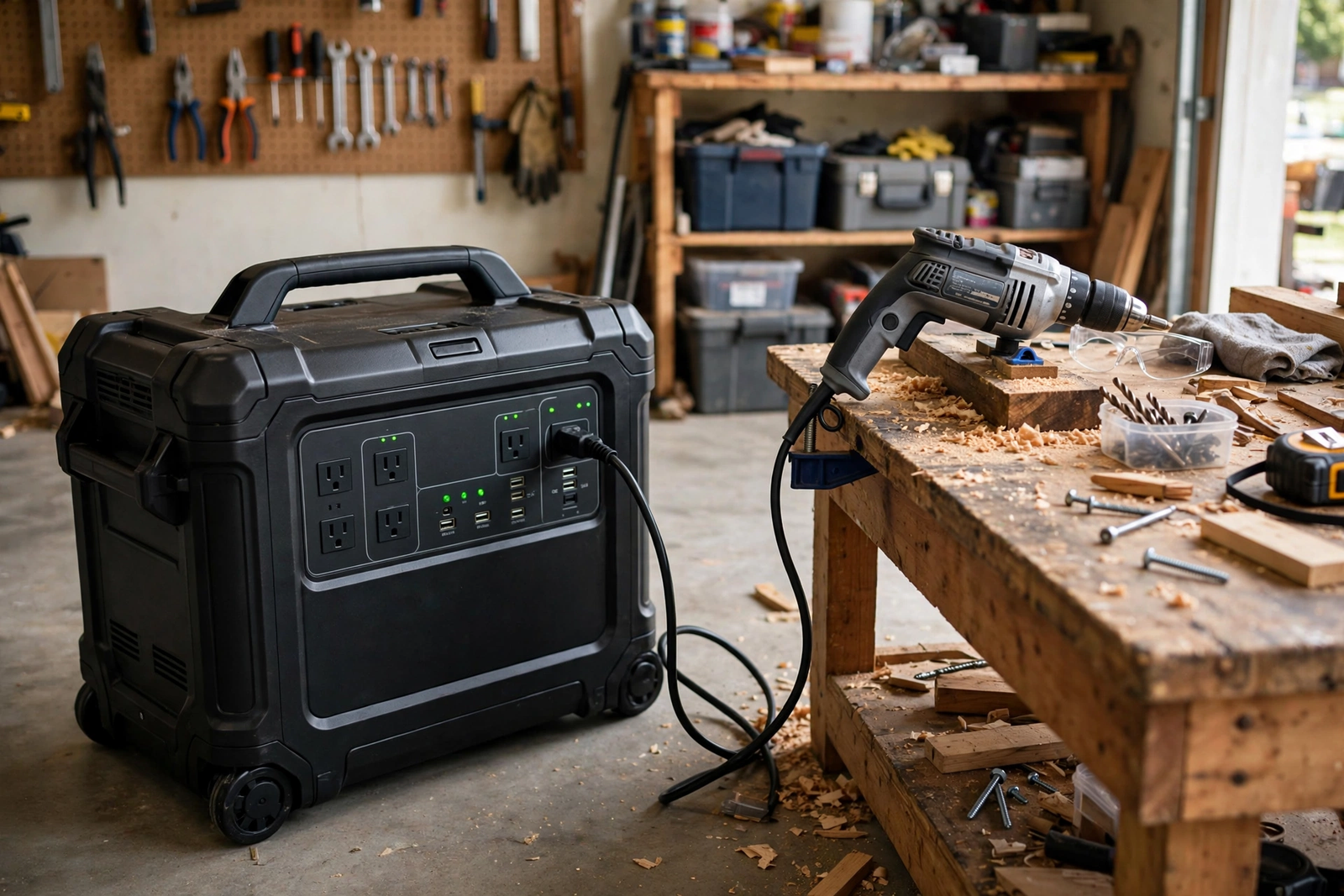
6 Bluetti AC200L
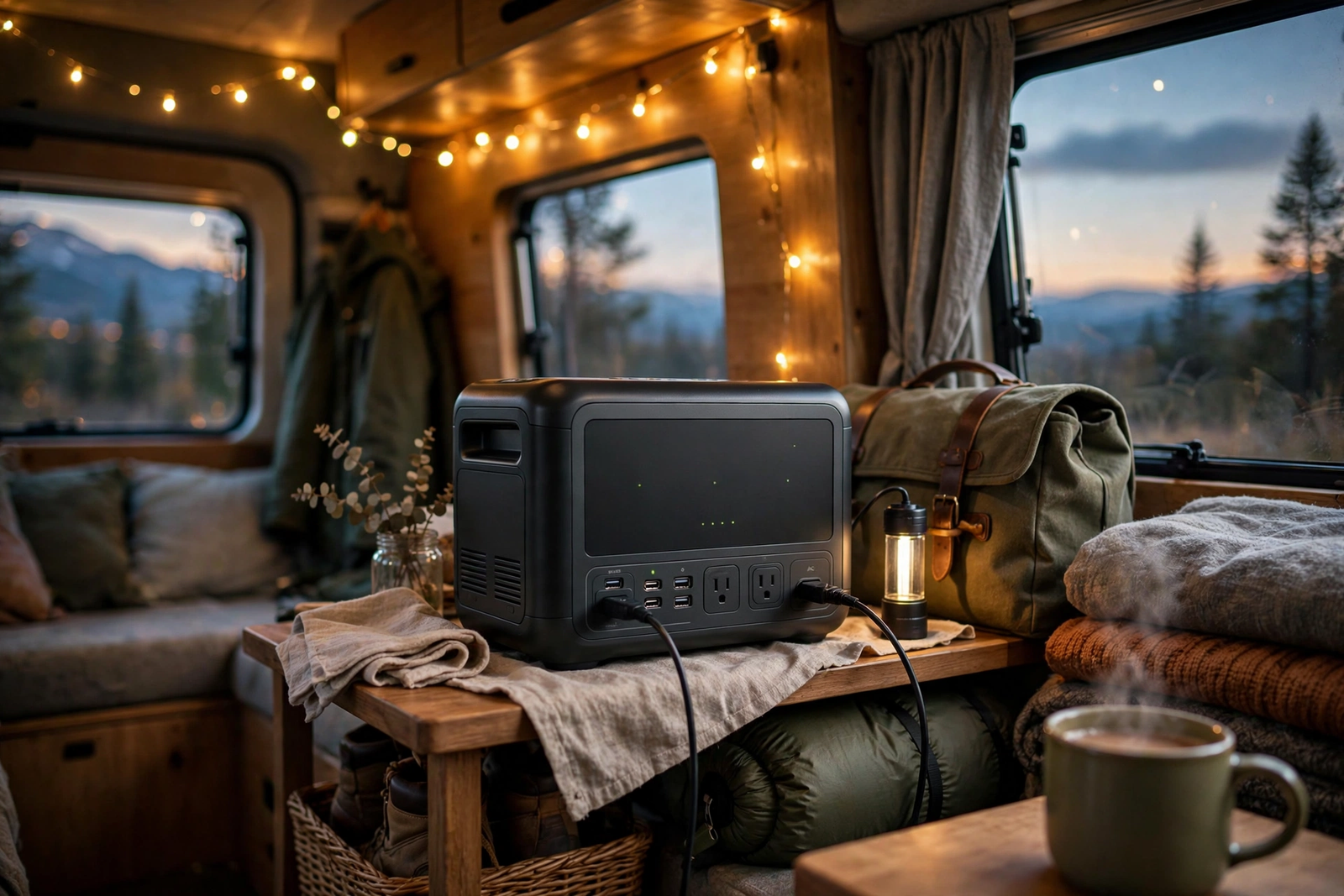
Best for: serious outage coverage at homeThe home-backup machine. 2048Wh, 2400W AC (3600W Power Lifting), 61.4 lbs. It runs a fridge plus everything else through a long outage, and it expands all the way to 8192Wh with extra batteries, which moves it firmly into dedicated backup territory.
It charges 0-80 percent in 45 minutes, accepts up to 1200W of solar input, and has a 30A RV port. Let us be clear about the tradeoff: at 61.4 lbs, this is not portable in any real sense. It lives where you put it. But if the job is “keep the house’s essentials alive for a day or more,” this is built for it.
| Capacity | 2048Wh LiFePO4 |
| AC Output | 2400W (3600W Power Lifting) |
| Weight | 61.4 lbs |
| Recharge | 0-80% in 45 min |
• Expandable to 8192Wh
• 2400W output with high surge
• 1200W solar input, 30A RV port
• 61.4 lbs, not really portable
• Overkill unless you need it
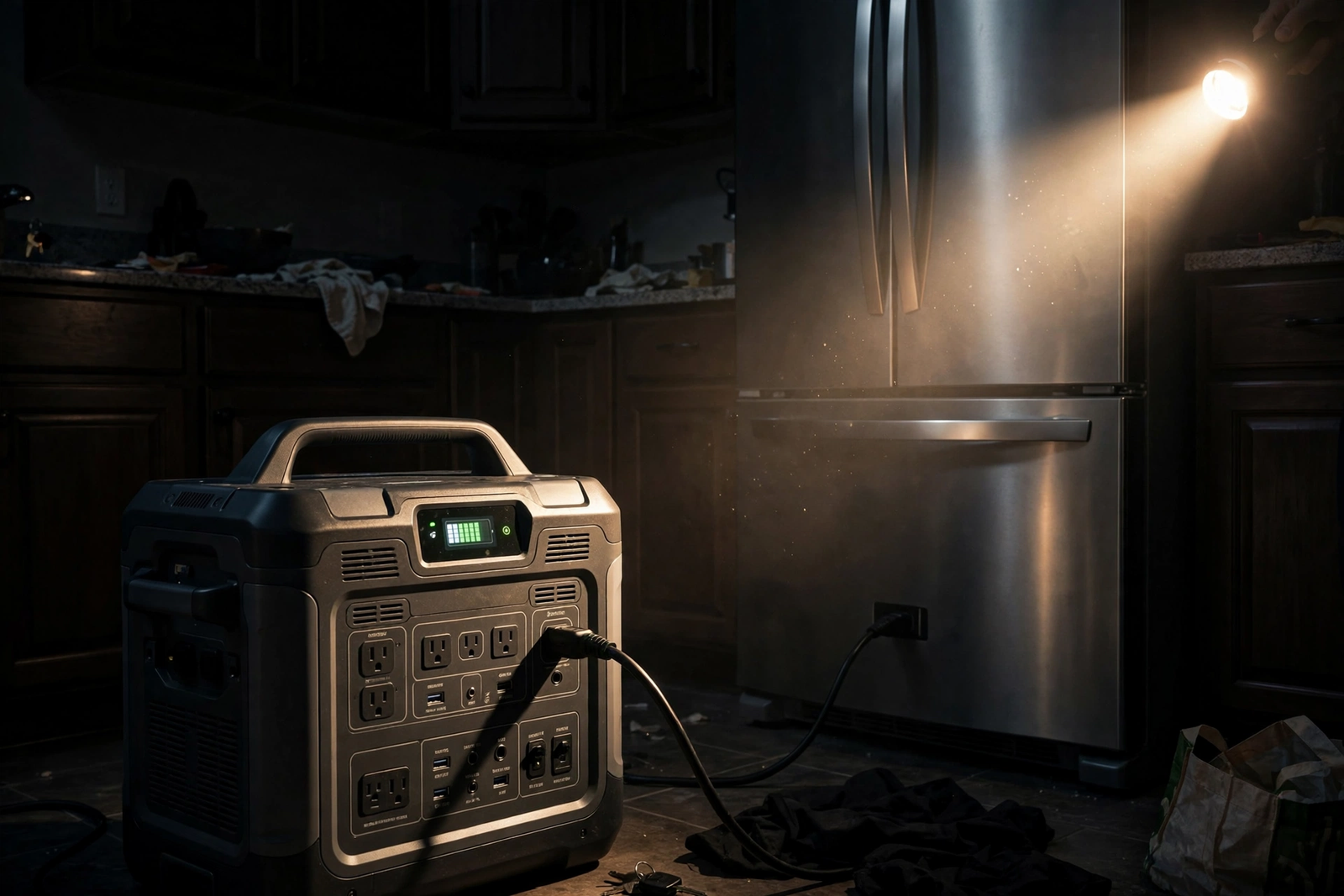
7 EcoFlow Delta 2 Max
Best for: doubling the Delta 2 formulaThe Delta 2’s bigger brother. 2048Wh, 2400W AC, about 50 lbs. Same excellent ecosystem and charging speed as the Delta 2, with double the capacity and an expandable design. It fast-charges in about an hour from AC, which is remarkable for a unit this size.
Choose this over the AC200L if you are already in the EcoFlow ecosystem or want faster standard charging and a slightly lighter box. Choose the AC200L if you want maximum expansion and the RV port. Either way, this tier is for people whose sizing math genuinely lands at 2000Wh or more.
| Capacity | 2048Wh LiFePO4 |
| AC Output | 2400W |
| Weight | ~50 lbs |
| Recharge | ~1 hour fast charge (AC) |
• Double the Delta 2 capacity
• About 1-hour fast charge
• Expandable design
• ~50 lbs is furniture, not portable
• Only worth it if your math says so
Our Verdict
Sizing a portable power station comes down to one calculation: add up your device watts, multiply by the hours you need, and divide by 0.85. Do that before you shop, and you will not go wrong. For most people, the answer lands in the medium tier, and the EcoFlow Delta 2 is the safest single choice there. 1024Wh covers a fridge through a typical outage, 1800W handles everything realistic you will plug in, it recharges in under an hour, and the 5-year warranty backs it up. Size it, buy it, charge it, and forget about it until the lights go out.
Frequently Asked Questions
Prefer to just punch in your devices? The Power Station Runtime Finder does the maths for you — pick a scenario, add your load, and get the size class you actually need.
Pingback: Best Portable Power Station for CPAP Machines (2026)
Pingback: How Long Will a Power Station Run a Refrigerator? (2026)