
If you’re looking for the best portable power station for CPAP machines, you already know the feeling. The power flickers, the room goes quiet, and your first thought is not about the fridge or the Wi-Fi. It is about tonight. A dead battery on a CPAP night is not an inconvenience. It is hours of bad sleep waiting to happen.
Here is the good news. Portable power stations have become some of the best CPAP backups you can buy, and the math behind them is simple enough to do on a napkin. Take the station’s watt-hours, shave off about 15 percent for conversion loss, then divide by your machine’s watt draw. That is your runtime. We ran that exact math for every station on this list, so you can see your hours before you spend a dollar.
Two things are worth knowing before we get into the picks. First, every station here puts out pure sine wave power, which is what CPAP machines require. Cheap modified sine wave inverters can buzz, throw errors, or damage a machine, so we excluded them completely. Second, your humidifier setting matters more than which station you buy. A CPAP with the humidifier and heated tube off draws roughly 30 to 60 watts. Switch the humidifier on and that doubles to 60 to 90 watts. Try one night with the humidifier off or on low before you pay for a bigger battery. It can turn a borderline pick into a comfortable two-night setup.
One last note: none of these can go on a commercial flight. Airlines cap spare batteries at 160Wh for carry-on, and every pick here is well above that. This guide is for car camping, RVs, and home backup. With that out of the way, here are the five stations we would actually buy.
- Best overall: Jackery Explorer 1000 v2. Lightest and quietest in the 1kWh class at 23.8 lbs, with roughly 22 hours of CPAP runtime when the humidifier is off.
- Longest runtime per dollar: Bluetti AC180. 1152Wh, the only pick here that comfortably covers two humidified nights, plus UPS mode for seamless home backup.
- Fastest recharge: Anker Solix C1000. Goes from 0-80% in about 43 minutes, so even a short power window gets you back to nearly full.
- Budget travel pick: Jackery Explorer 300 Plus. Only 7.1 lbs and backpack friendly. Covers one night if you run the humidifier low or off.
- The golden rule: a CPAP draws 30-60W without the humidifier and 60-90W with it. Turn the humidifier down and you roughly double your runtime.
Best Portable Power Station for CPAP Machines: Top Picks at a Glance
Jackery Explorer 1000 v2
The quietest, lightest 1kWh station here. About 22 hours of CPAP runtime per charge.
EcoFlow Delta 2
Refills to 80% in 50 minutes and doubles as a whole-home backup for fridge and Wi-Fi.
Bluetti AC180
The biggest battery here with UPS mode. Maximum nights per dollar, at the cost of weight.
Anker Solix C1000
0-80% in 43 minutes and expandable later. Anker polish on a 1kWh box.
Jackery Explorer 300 Plus
7.1 lbs of backpack-friendly backup. One night of CPAP if you manage the humidifier.
Detailed Reviews
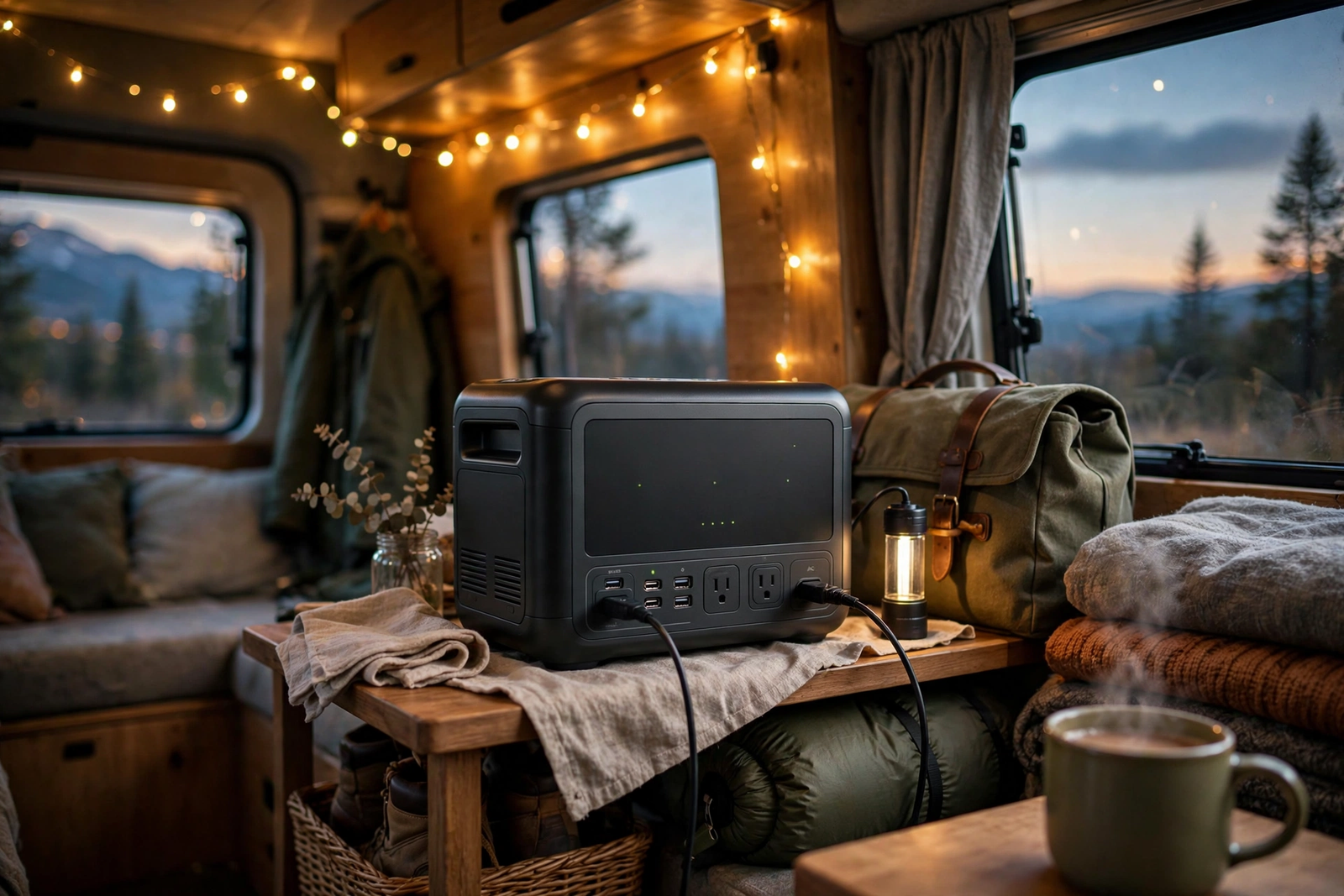
1 Jackery Explorer 1000 v2
Best OverallThe Explorer 1000 v2 is the station we would hand to a first-time buyer, no hesitation. At 23.8 lbs it is the lightest station in the 1kWh class on this list, the handle folds flat so it slides behind a car seat, and owners report that it runs very quiet. Quiet is not a luxury feature when the station sits next to your bed or inside a tent. It is the whole point.
The runtime math: 1070Wh x 0.85 / 40W, a typical CPAP draw with the humidifier off, comes to roughly 22 hours. That is two full nights with margin to spare. Run the humidifier at 70W and you still get about 13 hours, a full night. If your machine draws closer to 30W, expect even more. The Jackery app earns its keep here too: a one-hour emergency charge mode and phone-based battery monitoring mean you are not fumbling with buttons in the dark when the power goes out.
Who it is for: CPAP users who want one station covering both outages and camping, and who care about quiet, light, and simple. Who should skip: anyone chasing maximum battery per dollar without caring about weight. The Bluetti AC180 below gives you more watt-hours for less money.
| Capacity | 1070Wh LiFePO4 |
| AC Output | 1500W (3000W surge) |
| Weight | 23.8 lbs |
| Recharge | ~1 hour emergency charge via app |
- Lightest station in the 1kWh class here
- Owners report very quiet operation
- Fold-flat handle, easy to tuck away
- Rated for 4000 cycles to 70% capacity
- Good app with emergency charge mode
- 1500W output is lower than the 1800W rivals
- Usually pricier per watt-hour than the AC180
- No UPS mode for seamless home backup
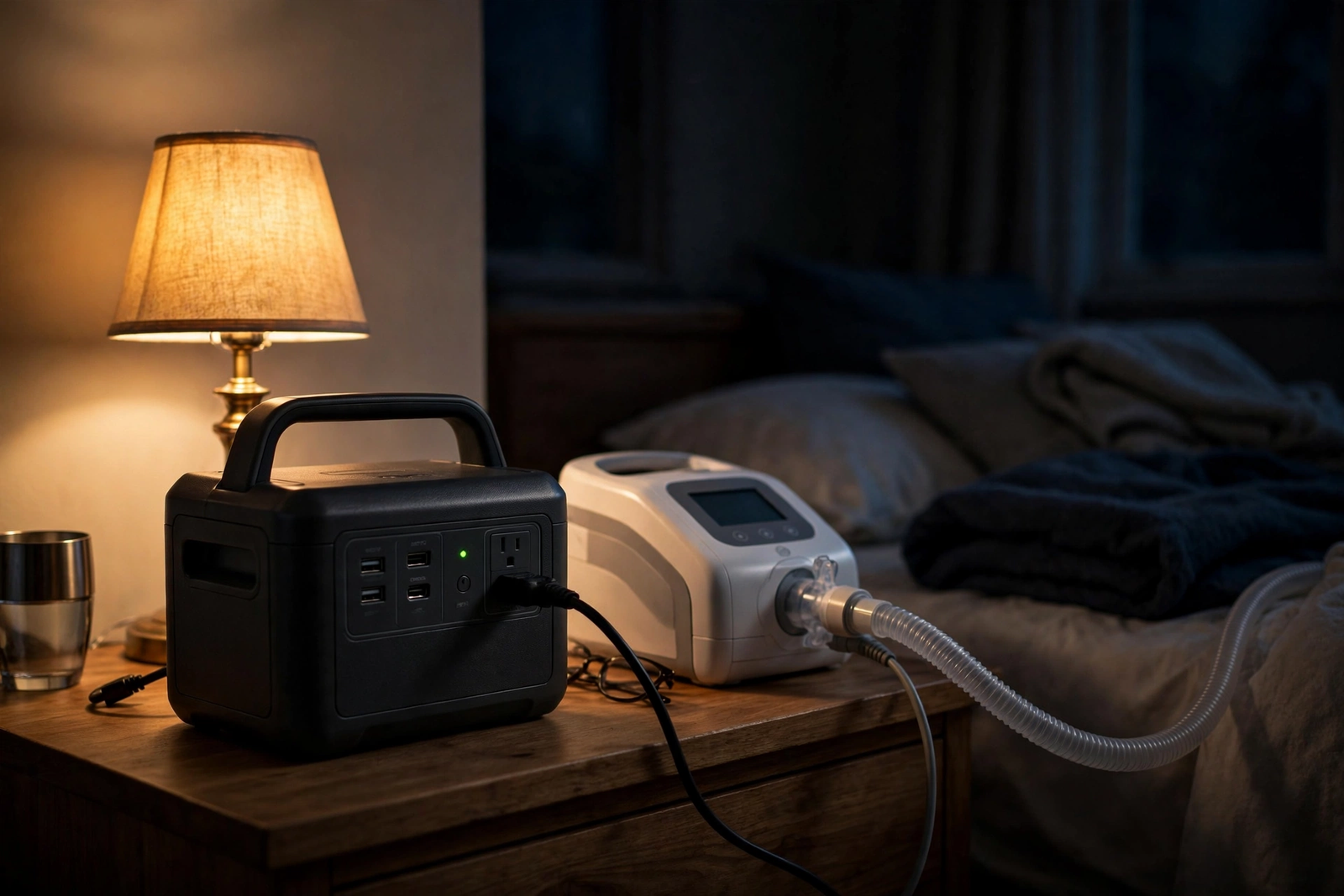
2 EcoFlow Delta 2
Best All-RounderThe Delta 2 is the workhorse of this category, and its reputation comes down to one thing: charging speed. It goes from empty to 80 percent in about 50 minutes on a wall outlet. For CPAP backup, that is more than convenience. It means even a short window of power, a friend’s house, a quick generator run, a rest stop outlet, gets you back to nearly full. Owners report it is the station they stop worrying about.
Runtime math: 1024Wh x 0.85 / 40W = roughly 21 hours with the humidifier off, about 12 hours with it on at 70W. Either way, a night is covered, and you get two-plus nights if you run the humidifier off. The 1800W output is overkill for a CPAP, but it makes the Delta 2 a genuine whole-home backup: fridge, Wi-Fi, and phones can run alongside your machine. A five-year warranty backs it up.
Who it is for: buyers who want the most versatile station for CPAP nights and general outage duty. Who should skip: anyone whose top priority is overnight silence (the Jackery 1000 v2 runs quieter) or who counts every pound (it is a few pounds heavier).
| Capacity | 1024Wh LiFePO4 |
| AC Output | 1800W (2700W surge) |
| Weight | 27 lbs |
| Recharge | 0-80% in 50 minutes on AC |
- Very fast AC charging (0-80% in 50 min)
- 1800W output handles real appliances
- 5-year warranty
- 3000 cycles to 80% capacity
- A few pounds heavier than the Jackery 1000 v2
- Not the quietest pick for bedroom use
- Pricier per watt-hour than the Bluetti AC180
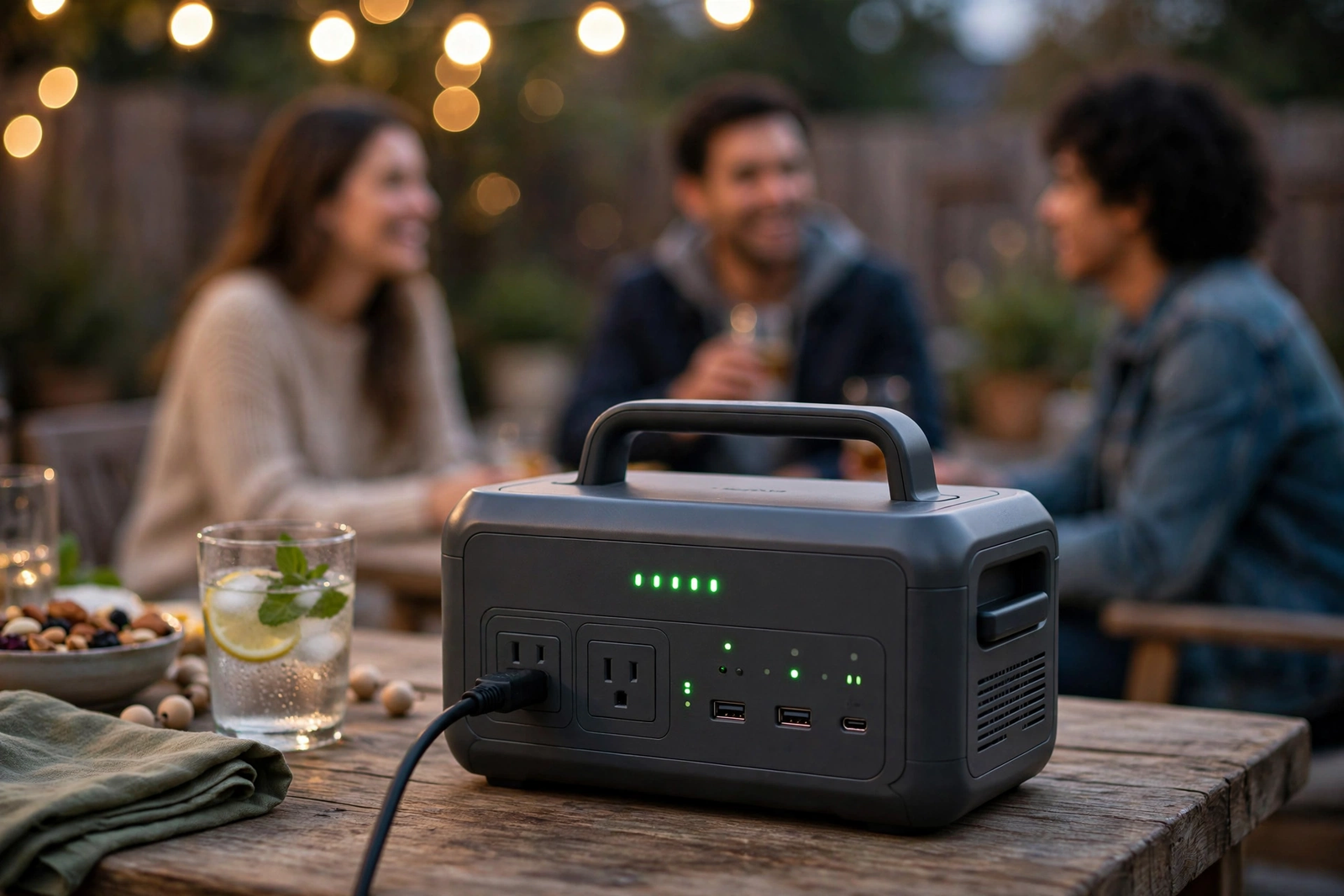
3 Bluetti AC180
Longest RuntimeThe AC180 has the biggest battery in this lineup and usually the lowest price per watt-hour. If your one question is “how many nights can I get,” this is your answer. The math: 1152Wh x 0.85 / 40W = roughly 24 hours with the humidifier off, about 14 hours with it on. It is the only pick here that covers two full humidified nights with room to spare.
The tradeoff is weight. At 35 to 37 lbs it is the heaviest of the 1kWh-class picks, which makes it more of a home-backup station than a camping companion. For home use it fights back with a standout feature: UPS mode. It can sit between the wall and your CPAP and switch over in milliseconds when the power drops. No scrambling in the dark, no missed therapy time.
Who it is for: home users whose main worry is overnight outages and who want maximum runtime per dollar. Who should skip: campers who will carry it far from the car. Look at the Jackery 1000 v2 or 300 Plus instead.
| Capacity | 1152Wh LiFePO4 |
| AC Output | 1800W (2700W surge) |
| Weight | 35-37 lbs |
| Recharge | 0-80% in 45 minutes (TurboBoost) |
- Biggest battery in this lineup
- Best price per watt-hour here
- UPS mode for seamless outage switchover
- 3500+ cycles, 5-year warranty
- Heaviest pick at 35-37 lbs
- Not a camping companion
- Larger footprint to store
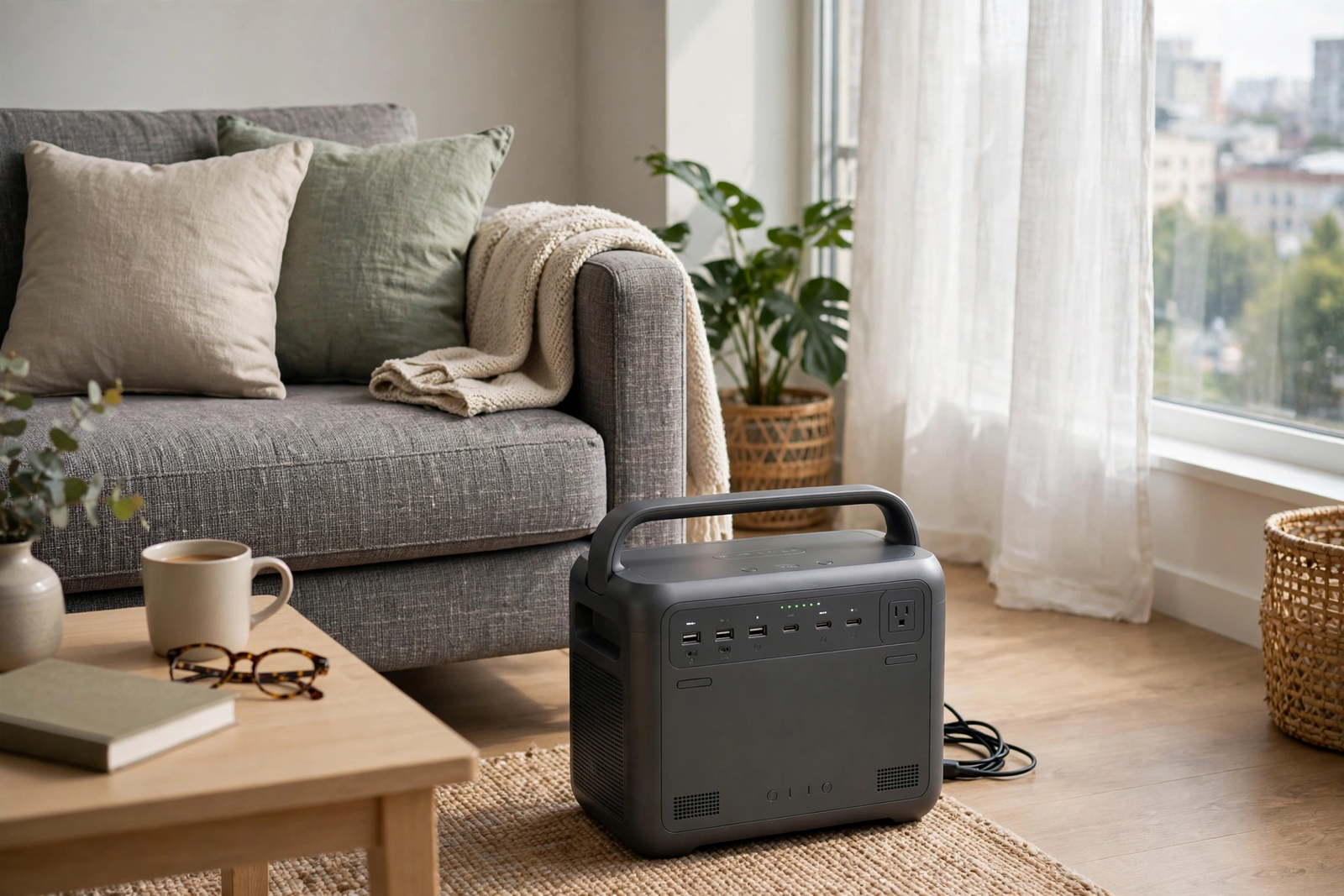
4 Anker Solix C1000
Fastest RechargeAnker built its name on phone chargers, and the Solix C1000 brings that engineering polish to a bigger box. Its headline trick is charging speed: 0-80% in roughly 43 minutes, the fastest claimed in this group. For CPAP backup, fast charging is strategy, not convenience. If you only get power for an hour a day, this is the station that fills up the most.
Runtime math: 1056Wh x 0.85 / 40W = roughly 22 hours with the humidifier off, about 13 with it on. Right in line with the Jackery and EcoFlow, as you would expect from similar capacity. It is also expandable with an extra battery if you ever outgrow it, and it accepts up to 600W of solar input, the highest here. Owners report the app and display are among the clearest in the category.
Who it is for: people who recharge from limited power windows, or who want the option to expand capacity later. Who should skip: if you will mostly charge overnight from a wall outlet, the Jackery or EcoFlow deliver the same runtime for usually less money.
| Capacity | 1056Wh LiFePO4 |
| AC Output | 1800W (2400W surge) |
| Weight | ~28 lbs |
| Recharge | 0-80% in ~43 minutes |
- Fastest recharge in this group
- Expandable with an extra battery
- 600W max solar input, highest here
- Clear app and display, owners report
- Same runtime as cheaper rivals
- Expansion battery costs extra
- Usually pricier than the Bluetti AC180
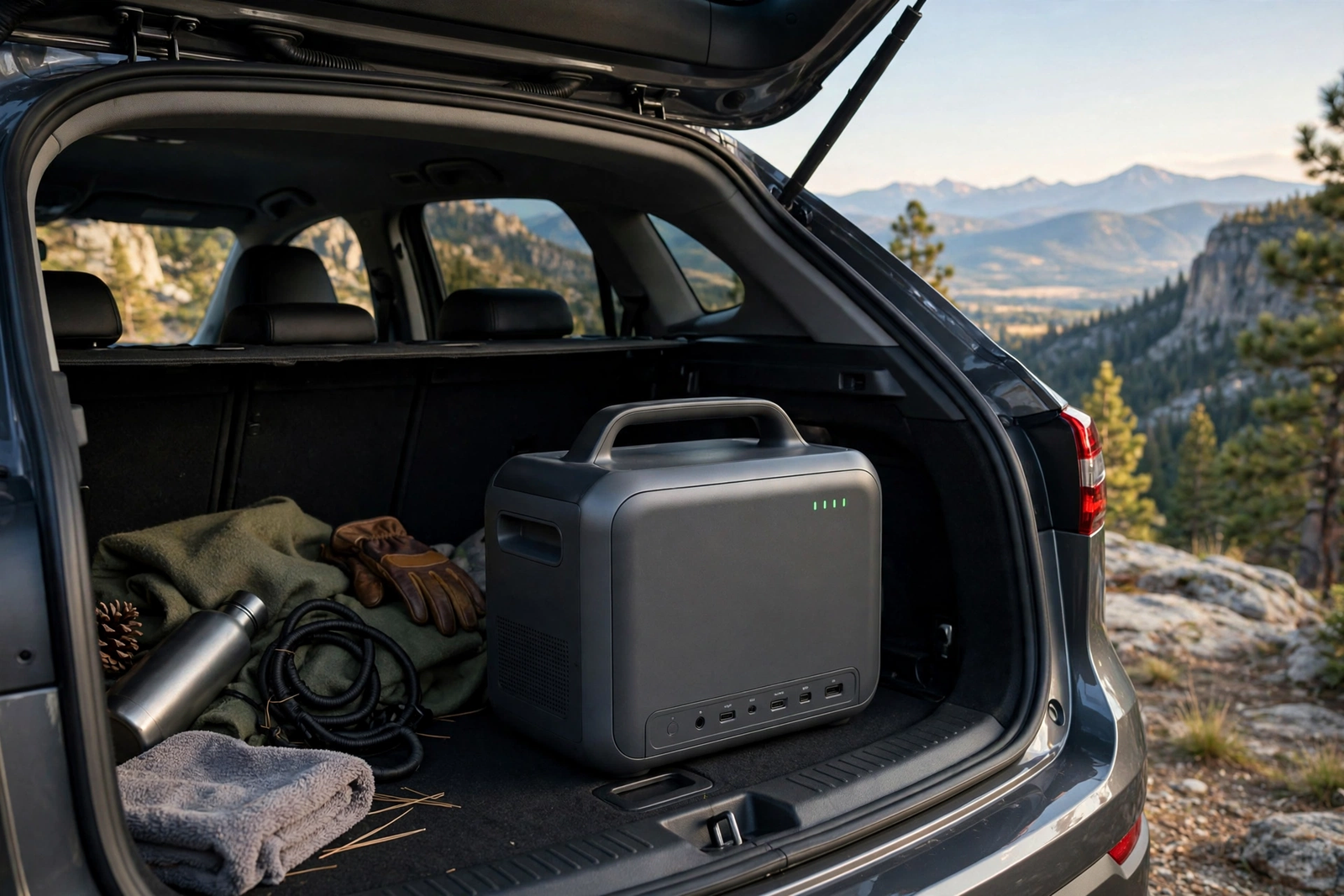
5 Jackery Explorer 300 Plus
Budget Travel PickNot every CPAP backup needs to be a 1kWh beast. The 300 Plus weighs 7.1 lbs, fits in a backpack, and covers a night of CPAP if you manage the humidifier sensibly. The math: 288Wh x 0.85 / 40W = roughly 6 hours. At a 30W draw, about 8 hours. With the humidifier cranked to 70W it drops to around 3.5 hours, which is not enough.
So here is the honest framing: it is a one-night backup for people who run the humidifier off or very low, or a second-night extender behind a bigger station. For car campers and road trippers, the size is the selling point. It recharges quickly, it is dead simple to use, and it keeps phones and a laptop topped up on a weekend trip.
Who it is for: travelers and campers who need a light, cheap one-night CPAP backup and can run the humidifier low or off. Who should skip: anyone who needs the humidifier on high all night, or multi-night coverage without recharging. Get one of the 1kWh picks above.
| Capacity | 288Wh LiFePO4 |
| AC Output | 300W (600W surge) |
| Weight | 7.1 lbs |
| Recharge | Fast AC top-up |
- Tiny and light at 7.1 lbs
- Dead simple, no learning curve
- Doubles as a phone and laptop bank
- Fast to top up between trips
- One night only, and only with the humidifier low or off
- 300W inverter cannot run heated appliances
- Not a primary solution for heavy humidifier users
Our Verdict
The Jackery Explorer 1000 v2 is our top pick for CPAP users. It delivers around 22 hours of humidifier-free runtime, it is the lightest and quietest of the full-size picks, and the app makes outage management easy. If your priority is the most battery for the least money, the Bluetti AC180 runs longer per dollar and adds UPS mode for seamless home backup. And if you want something that disappears into a backpack for car camping, the Jackery Explorer 300 Plus covers a night for a fraction of the cost, as long as you keep the humidifier low. Whichever you choose, run the runtime math with your machine’s actual watt draw, and you will sleep fine.
Frequently Asked Questions
Not sure which size your machine actually needs? Run your numbers in our free Power Station Runtime Finder — it works out the exact station size for your CPAP in about a minute.
Pingback: Best Portable Power Station Under $500 (2026)
Pingback: How Long Will a Power Station Run a Refrigerator? (2026)
Pingback: What Size Portable Power Station Do I Need? (2026 Guide)