
Your observatory is a concrete slab with a railing, a view of the parking lot, and a sky that glows orange all night. That is exactly what the best telescope for balcony stargazing is built for: small spaces and city skies. It still counts. Some of the most consistent stargazers in the hobby observe from balconies, because the best telescope location is not the darkest one. It is the one you will actually use on a Tuesday night when the Moon looks interesting and the couch looks comfortable.
Balcony astronomy has real constraints, and an honest guide starts with them. Space is tight: the scope must fit through a doorway, share the balcony with a chair, and store in a closet. Light pollution washes out faint targets no matter what you buy. Setup time decides everything: a 15-minute assembly means you observe twice a year, while a 3-minute carry-out means you observe weekly. And there are neighbors: nobody wants a buzzing motor or a bright screen flooding the balcony next door at midnight.
The good news is that the brightest, most rewarding targets in the sky do not care about city lights. The Moon, the planets, colorful double stars, and bright star clusters punch straight through light pollution. A small, quiet, grab-and-go telescope aimed at those targets will show you more in a year than a giant scope that never leaves the closet. This guide picks four telescopes built for exactly that life: compact, quick to set up, quiet, and honest about what city skies allow.
Nothing here comes from hands-on testing. Every claim is grounded in manufacturer spec sheets, reviewer findings, and owner reports.
- Balcony astronomy works: the Moon, planets, double stars, and bright clusters punch through city glow.
- Faint galaxies and most nebulae need dark skies, so do not buy a balcony scope for them.
- Grab-and-go wins: a scope you can carry out in one trip gets used far more than a bigger one.
- Manual scopes are silent; smart scopes make only soft motor whirs, so neighbors will not notice.
- On a small balcony, a stable compact mount matters more than raw aperture.
- Setup under five minutes is the difference between observing and staying on the couch.
Best Telescope for Balcony Stargazing: Top Picks at a Glance
ZWO Seestar S30
Best overall for balconies. Tiny smart telescope that stacks images through city glow.
Celestron StarSense Explorer LT 80AZ
Best traditional scope. Light 80mm refractor with phone-guided finding.
Gskyer 70mm AZ70400
Best travel and compact budget pick. One-hand carry, closet-friendly.
Celestron AstroMaster 70AZ
Best budget classic. Long-tube 70mm with great Moon and planet views.
What Works From a Balcony
Forget the deep-sky glamour shots for a moment. The city-sky greatest hits list is long, and every item on it looks great from a balcony.
The Moon is the undisputed champion of balcony astronomy. Light pollution is irrelevant to it, it rewards any telescope, and it looks different every night as the terminator sweeps across craters and mountains. A 70mm scope at 90x shows crater chains, mountain shadows, and the smooth maria in sharp relief.
The planets are the second pillar: small and bright, nearly immune to light pollution. Saturn’s rings resolve at 60x and up, Jupiter shows cloud bands and four moons in a 70mm scope, Venus shows phases, and Mars shows its orange disk. The city costs you nothing here.
Double stars are the connoisseur’s city target. Albireo in Cygnus splits into a gold and blue pair, and Mizar with Alcor plus the Double Double in Lyra all split cleanly at modest power. Doubles are point sources, so city glow barely touches them.
Bright star clusters survive the city better than you would expect. The Pleiades, the Beehive, and the Double Cluster in Perseus all sparkle even under orange skies. Start with open clusters; they fare better than globulars in light pollution.
Bright nebulae are the partial win. The Orion Nebula shows its glowing core and the Trapezium stars even from downtown in winter; the Lagoon Nebula cooperates in summer. Expect glowing cores rather than sprawling wings.
Tactical advice: aim high. Targets near the zenith sit above most of the city’s light dome and look far better than anything near the horizon. Turn off your balcony lights, give your eyes 10 minutes, and favor sessions after midnight when many commercial lights shut off.
What Does Not Work From a Balcony
Honesty now, to protect your wallet. Faint galaxies are the main casualty: Andromeda is a dim smudge at best from a typical city balcony, and most galaxies are simply invisible. Sweeping Milky Way views do not happen under orange skies, and faint nebulae like the Veil or the Horsehead are out of reach for visual observing in the city.
This does not mean a balcony scope is a compromise scope. It means it is a specialist scope. Buy for the bright targets above, love it for them, and treat dark-sky trips as a separate adventure. The one exception is the smart telescope pick below: by stacking hundreds of short exposures, it photographs deep-sky objects your eye cannot see from the city, which genuinely changes what a balcony can do.
Why Compact and Grab-and-Go Wins
Experienced observers repeat one rule like a mantra: the best telescope is the one you use. On a balcony, that rule has teeth. A big scope that takes 15 minutes to assemble and two trips through the living room gets used on perfect Saturdays, maybe six times a year. A small scope you grab with one hand and set up in three minutes gets used on whims, 40 times a year. The small scope wins by a landslide.
Weight and footprint decide this more than optical specs. A 13-pound tube plus a 24-pound base is a wonderful instrument and a terrible balcony companion. Everything in this guide carries out in one trip and stores in a closet.
Noise is the constraint nobody mentions until a neighbor does. Manual telescopes are silent, which makes them perfect balcony citizens. Smart telescopes use small motors to find and track targets, but owners describe them as soft whirs, quieter than a conversation. Either way, nobody’s sleep is at stake.
Detailed Reviews
1
ZWO Seestar S30
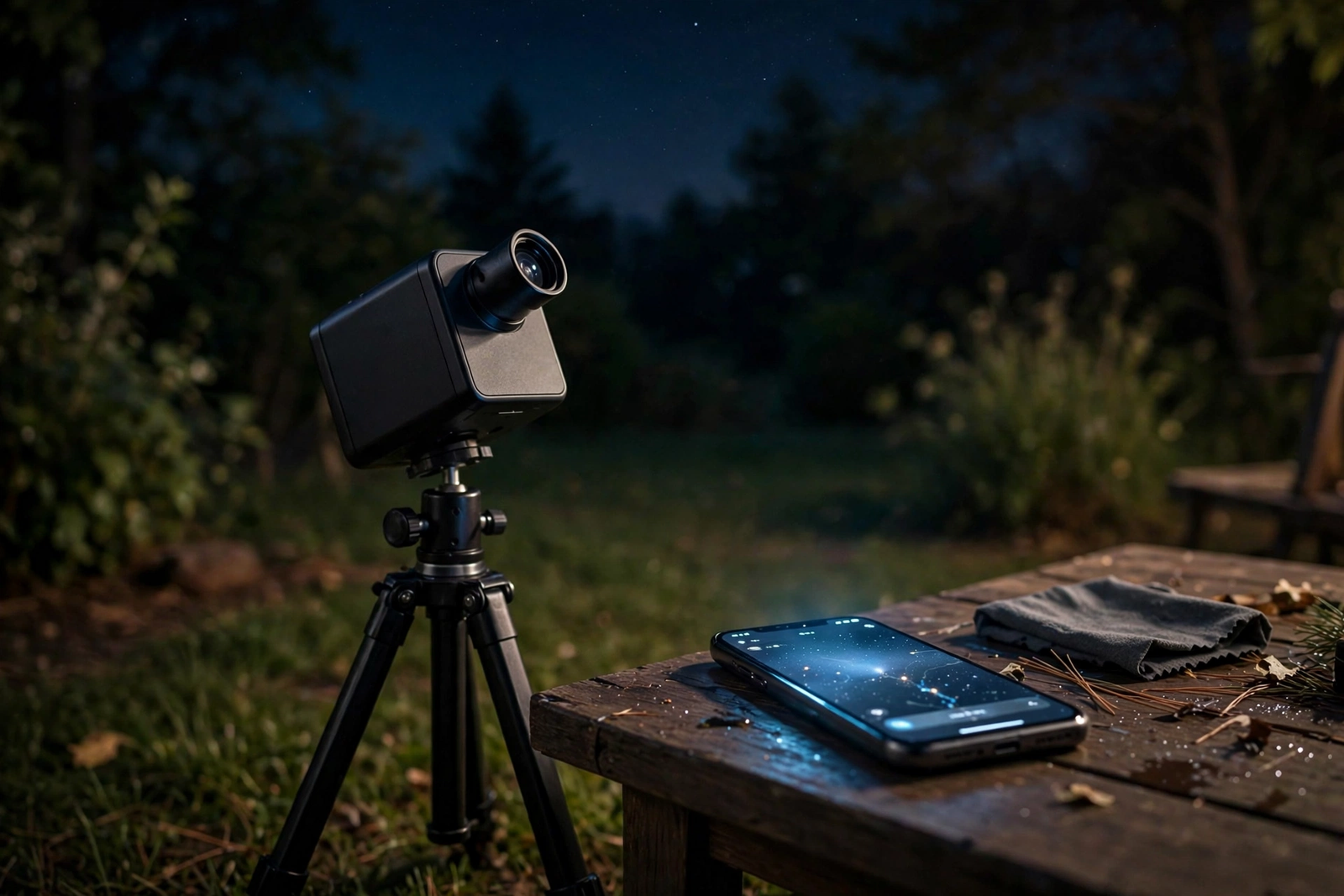
The Seestar S30 is a 30mm smart telescope that rethinks what a city balcony can do. There is no eyepiece: you place the tiny unit on its tripod, connect your phone over Wi-Fi, tap a target in the app, and the S30 finds it, tracks it, and stacks live images on your phone screen. It carries a dual-band filter for nebulae and includes a solar filter for safe daytime Sun viewing.
Why it wins for balconies: live stacking punches through light pollution in a way no eyepiece can. From an orange-sky balcony, the S30 builds images of the Orion Nebula, bright clusters, and even galaxies that your eye would never catch from the same spot. Setup takes minutes, operation is nearly silent, and you observe from your balcony chair, phone in hand. The price tier runs roughly $300 to $400, often $349 on sale.
The honest limit: 30mm of aperture is not built for planets. Jupiter and Saturn appear small in the S30’s images, without the crisp detail an 80mm refractor shows at the eyepiece. This is a deep-sky camera that happens to be shaped like a telescope, so buy it for nebulae and clusters, not for Saturn’s rings.
Who it is for: City dwellers who want photos of nebulae and clusters from the balcony, and tech-comfortable beginners who prefer a screen to an eyepiece. Who should skip it: Planet lovers (choose an eyepiece scope below) and purists who want photons hitting their retina directly.
| Aperture | 30mm smart telescope |
| Control | Fully app-controlled GoTo via phone |
| Imaging | Live stacking, dual-band filter, solar filter included |
| Viewing | Phone screen (no eyepiece) |
| Noise | Soft motor whirs only |
| Portability | Tiny; fits on a balcony table |
| Price tier | Roughly $300 to $400, often $349 on sale |
- Stacks through city light pollution
- Finds and tracks targets automatically
- Tiny footprint
- Solar filter included
- Quiet operation
- 30mm aperture is not a planet instrument
- No traditional eyepiece viewing
- Requires a charged phone
2
Celestron StarSense Explorer LT 80AZ
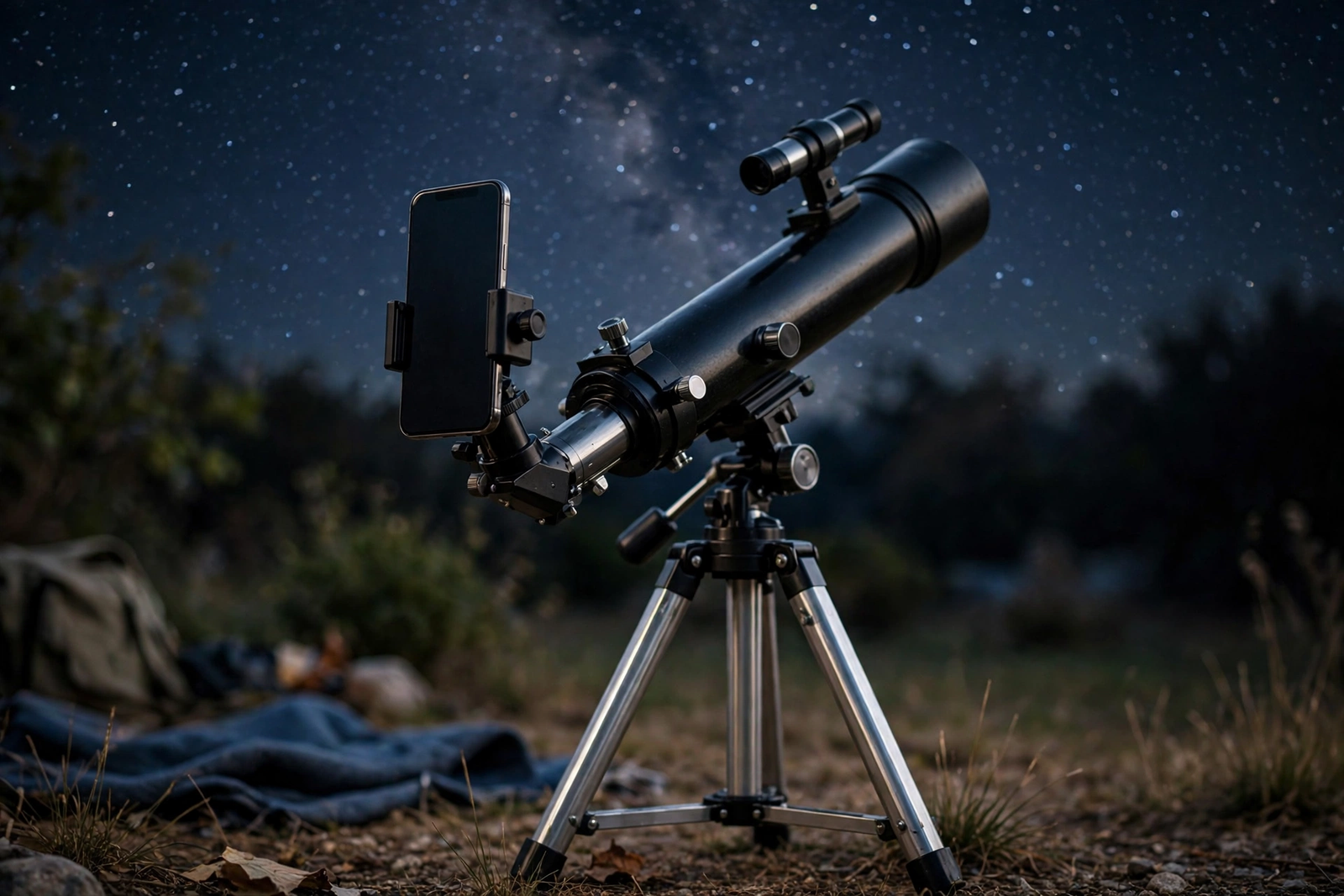
For observers who want to look through glass rather than at a screen, the LT 80AZ is the balcony-friendly classic. The 80mm f/11 refractor on a light manual mount reaches 36x with the 25mm eyepiece and 90x with the 10mm, exactly where the Moon turns spectacular and Saturn’s rings snap into shape. The StarSense dock uses your phone’s camera to recognize the sky and walks you to targets with on-screen arrows: less hunting, more observing.
On a balcony, three traits matter: light enough for one-trip carry, a tripod that folds small for closet storage, and silence, with no motors at all. Its best targets (Moon, planets, double stars) are precisely the ones city skies allow. One planning note: the 900mm tube is long, so give it swing room where the railing will not block its arc. A 2-year warranty backs the optics; the price tier sits in the mid-$200s.
Who it is for: Traditional observers who want real eyepiece views from a small space. Who should skip it: Anyone who wants deep-sky photos from the city (see the S30 above), and observers with extremely tight balconies where a long tube cannot swing.
| Aperture | 80mm refractor |
| Focal length / ratio | 900mm, f/11 |
| Included eyepieces | 25mm (36x), 10mm (90x), 2x Barlow |
| Finder | StarPointer red-dot + StarSense phone dock and app |
| Mount | Manual alt-azimuth (silent) |
| Warranty | 2-year |
| Price tier | Mid-$200s tier |
- Excellent Moon and planet optics for the size
- Phone guidance maximizes short sessions
- Light one-trip carry
- Completely silent
- 2-year warranty
- Long tube needs swing room on tight balconies
- Visual only, no photography path
- Phone needed for the guidance feature
3
Gskyer 70mm AZ70400
The Gskyer AZ70400 is the smallest, cheapest legitimate telescope in this guide, and on a balcony those are features, not compromises. The short 400mm tube (f/5.7) weighs roughly 5.7 pounds, sets up in minutes, and packs into the included carry bag for closet storage. The kit is generous for the price tier around $110: 25mm (16x) and 10mm (40x) eyepieces, a 3x Barlow, a 5×24 finder, a phone adapter with wireless remote, and the bag.
For balcony use, its wide-field nature is a genuine asset: at 16x to 40x it frames the Pleiades, the Beehive, and the Moon beautifully, with Jupiter’s moons and Saturn’s ring shape within reach. Past 40x to 60x the fast focal ratio shows false color and softness, and owners report fiddling to align the finder, so align it in daylight first. As a grab-and-go balcony scanner, it is hard to argue with the footprint and the price.
Who it is for: Renters, kids, and anyone who wants the smallest possible real telescope. Who should skip it: Detail seekers who want crisp high-power planet views.
| Aperture | 70mm refractor |
| Focal length / ratio | 400mm, f/5.7 |
| Included eyepieces | 25mm (16x), 10mm (40x), 3x Barlow |
| Extras | Phone adapter, wireless remote, carry bag |
| Mount | Manual alt-azimuth (silent) |
| Weight | About 5.7 lbs |
| Price tier | Around $110 tier |
- Tiniest footprint here
- One-hand carry
- Carry bag included for closet storage
- Generous kit
- Silent
- Soft past 40x to 60x
- Finder alignment takes patience
- Not a high-power planet scope
4
Celestron AstroMaster 70AZ
The AstroMaster 70AZ is the long-tube classic: a 70mm f/13 refractor reaching 45x with the 20mm eyepiece and 90x with the 10mm. That slow focal ratio is kind to the Moon and planets, delivering clean, high-contrast views with minimal false color. At a price tier commonly around $150, its lunar and planetary performance explains its long popularity.
On the balcony, it is a study in trade-offs. The optics reward you on exactly the targets city skies allow. The mount is light, the scope is silent, and there are no batteries to charge. The cost is tube length: 900mm of refractor needs swing room, so measure your balcony before committing, and plan to observe targets high overhead where the long tube points most comfortably. The StarPointer red-dot finder works once aligned in daylight, and a 2-year warranty covers the optics.
Who it is for: Budget buyers who want classic eyepiece astronomy with genuinely good lunar and planetary views. Who should skip it: Owners of very tight balconies where a long tube cannot maneuver, and anyone wanting deep-sky imaging.
| Aperture | 70mm refractor |
| Focal length / ratio | 900mm, f/13 |
| Included eyepieces | 20mm (45x), 10mm (90x) |
| Finder | StarPointer red-dot |
| Mount | Manual alt-azimuth (silent) |
| Warranty | 2-year |
| Price tier | Budget tier, commonly around $150 |
- Great Moon and planet views for the price
- Slow f/13 ratio means clean high-power images
- Simple, silent, no batteries
- 2-year warranty
- Long tube needs swing room
- Narrow field for wide sweeping
- 70mm limits deep-sky reach
One step-up note for smart-scope shoppers: ZWO also sells larger smart telescopes for observers who outgrow the S30, including the Seestar S50 with its bigger 50mm aperture and the newer S30 Pro. Search “ZWO Seestar S50” on Amazon for the current listing.
Side-by-Side Comparison
| Telescope | Carry | Best balcony targets | Setup time | Price tier |
|---|---|---|---|---|
| ZWO Seestar S30 | Tabletop tiny | Nebulae, clusters, galaxies (stacked photos) | Minutes | $300 to $400, often $349 on sale |
| Celestron StarSense Explorer LT 80AZ | One trip, light | Moon, planets, double stars | Minutes | Mid-$200s |
| Gskyer 70mm AZ70400 | One hand, 5.7 lbs | Moon, bright clusters, wide fields | Minutes | Around $110 |
| Celestron AstroMaster 70AZ | One trip, long tube | Moon, planets at high power | Minutes | Around $150 |
Our Verdict
The best balcony scope is the one that makes it outside. That rule decides this category more than any specification. To photograph nebulae and clusters through city glow from your balcony chair, take the ZWO Seestar S30: nothing else this size pulls deep-sky detail out of orange skies. For the traditional eyepiece experience, the Celestron StarSense Explorer LT 80AZ is the one: excellent Moon and planet optics, phone guidance for productive 20-minute sessions, silent one-trip portability. If the budget is the boss, the Gskyer 70mm AZ70400 at around $110 is the smallest real telescope you can buy, and the Celestron AstroMaster 70AZ at around $150 is the better high-power classic if your balcony fits its long tube. Kill the balcony lights, aim high, and observe on Tuesdays, not just perfect Saturdays.