
Every compost tumbler on the market promises fast composting. Almost none of them mention what happens in January, which is exactly what the best compost tumbler for cold climates has to survive. Almost none of them mention what happens in January. The answer: ordinary uninsulated drums go dormant. Microbial activity collapses as internal temperatures fall, the pile freezes solid, and your “finished in 4 to 8 weeks” timeline stretches into spring. For gardeners in zones 6 and colder, winter is not a pause. It is half the year.
The fix is insulation. A small class of steel tumblers, led by Sweden’s Jora Composters, wraps the composting chamber in insulated, sealed walls that hold heat through freezing weather. They cost multiples of a plastic drum. They also keep working when everything else stops, which for cold-climate gardeners is the entire point.
This guide covers the insulated options that genuinely compost through winter, what “winter composting” realistically means, and the techniques that keep any tumbler alive in the cold. No hands-on testing is claimed. Everything below comes from manufacturer spec sheets, published reviewer findings, and owner reports.
- Ordinary plastic tumblers go dormant below about 40 F. Insulated steel tumblers can keep composting through freezing weather.
- The Jora JK270 (9.5 cu ft) and JK400 (14.2 cu ft) are the category leaders: insulated galvanized steel, sealed chambers, and documented operation in Scandinavian winters.
- Insulation does not make winter composting as fast as summer. Expect roughly double the processing time, and keep feeding the pile to sustain heat.
- The FCMP IM4000 is the budget winter strategy: not insulated, but cheap enough to pair with insulation techniques (siting, mass, browns management).
- Winter composting basics: keep the chamber at least half full, maintain browns, minimize door openings, and site the tumbler against a sun-facing wall.
Best Compost Tumbler for Cold Climates: Why Ordinary Tumblers Fail in Winter
Composting is a heat engine. Thermophilic microbes generate the 130 to 160 F temperatures that break waste down fast, but they need insulation to keep that heat from escaping into cold air. A thin plastic drum has almost no thermal mass: every cold night strips the day’s heat. Once the chamber drops near freezing, microbes go dormant and the pile becomes a frozen time capsule. Opening the door to add scraps makes it worse, dumping the remaining heat. This is physics, not a product defect, and no amount of turning fixes it.
What Insulation Actually Buys You
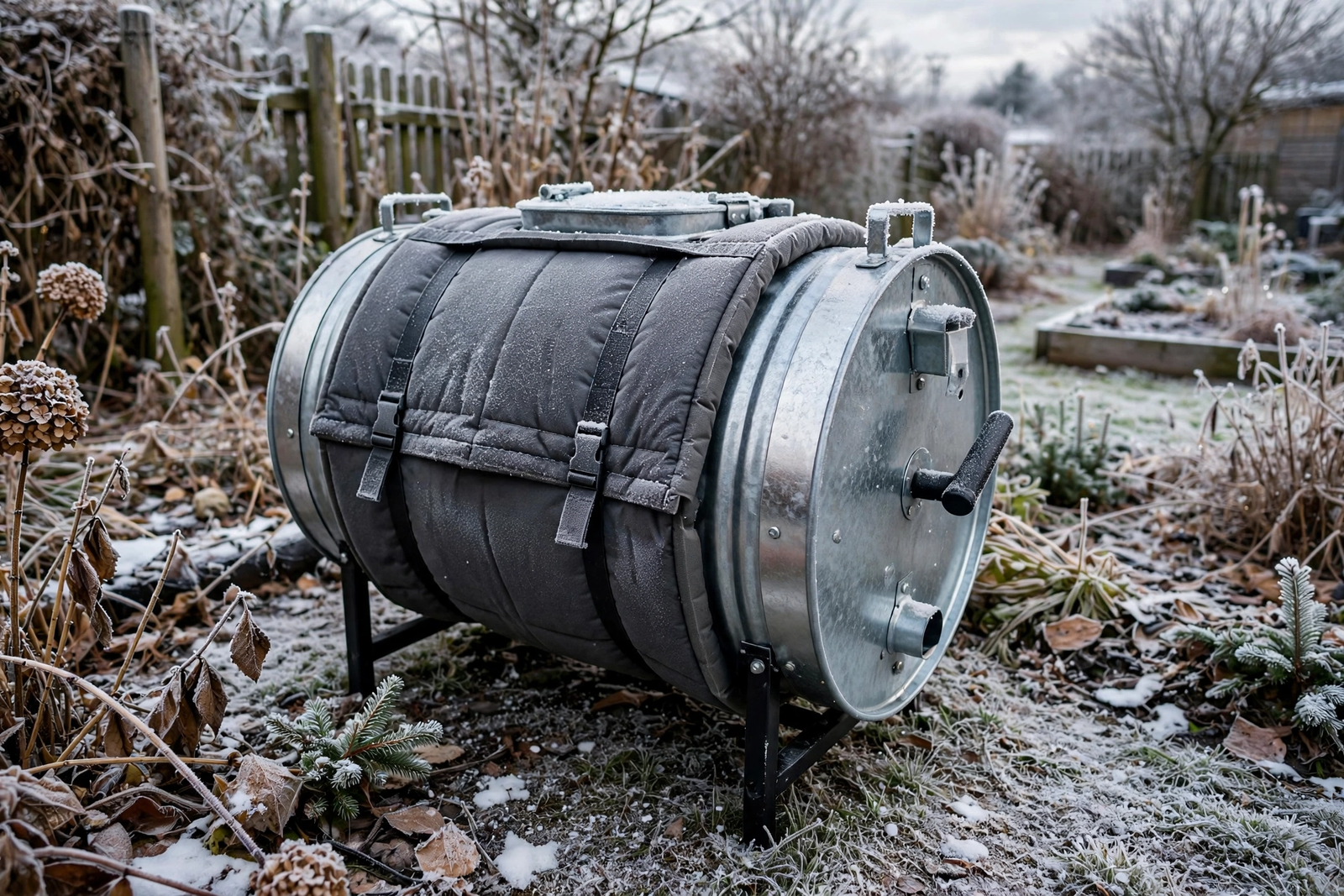
The Jora tumblers sandwich insulation between galvanized steel walls, and their sealed design excludes the cold drafts that kill plastic drums. Owners in Scandinavia and northern North America report internal temperatures holding above 140 F in the JK270 even in freezing conditions, with continuous feeding sustaining the heat. The sealed chambers also exclude rodents, a real winter problem as animals seek warm food sources. What insulation does not do: it does not make a half-empty chamber hot, and it does not compost faster than a summer pile. Mass matters. A full chamber holds heat; a quarter-full one does not, insulated or not.
Top Picks at a Glance
Jora JK270
Insulated steel, 9.5 cu ft. Genuine winter composting.
Jora JK400
14.2 cu ft insulated for large households and heavy use.
FCMP Outdoor IM4000
Not insulated, but winterizable with technique in moderate cold.
Detailed Reviews
1 Jora JK270 Insulated Tumbler
The JK270 is the reference standard for winter composting: 9.5 cubic feet (about 70 gallons) across two insulated chambers, galvanized steel construction inside and out, and a design proven in Swedish winters. It processes up to about 2.5 kg of waste per day, and owners report internal temperatures above 140 F in freezing conditions. The sealed design keeps rodents out, which matters more in winter than summer. At roughly $550 to $670 it costs several times a plastic drum, but it is the only tumbler in this guide that genuinely composts through a real winter.
Who it’s for: cold-climate gardeners who refuse a winter pause. Who should skip: warm-climate buyers and tight budgets.
| Capacity | 9.5 cu ft (about 70 gal), two insulated chambers |
| Construction | Galvanized steel, insulated walls |
| Throughput | Up to about 2.5 kg of waste per day |
| Winter performance | Internal temps above ~140 F reported in freezing weather |
| Price tier | Premium tier ($550-$670 range per current listings) |
- Genuine winter composting
- Rodent-proof sealed design
- Large capacity
- Proven in Scandinavian winters
- Premium price
- Heavy
- Needs level ground
- Slower in deep cold than summer
2 Jora JK400 Insulated Tumbler
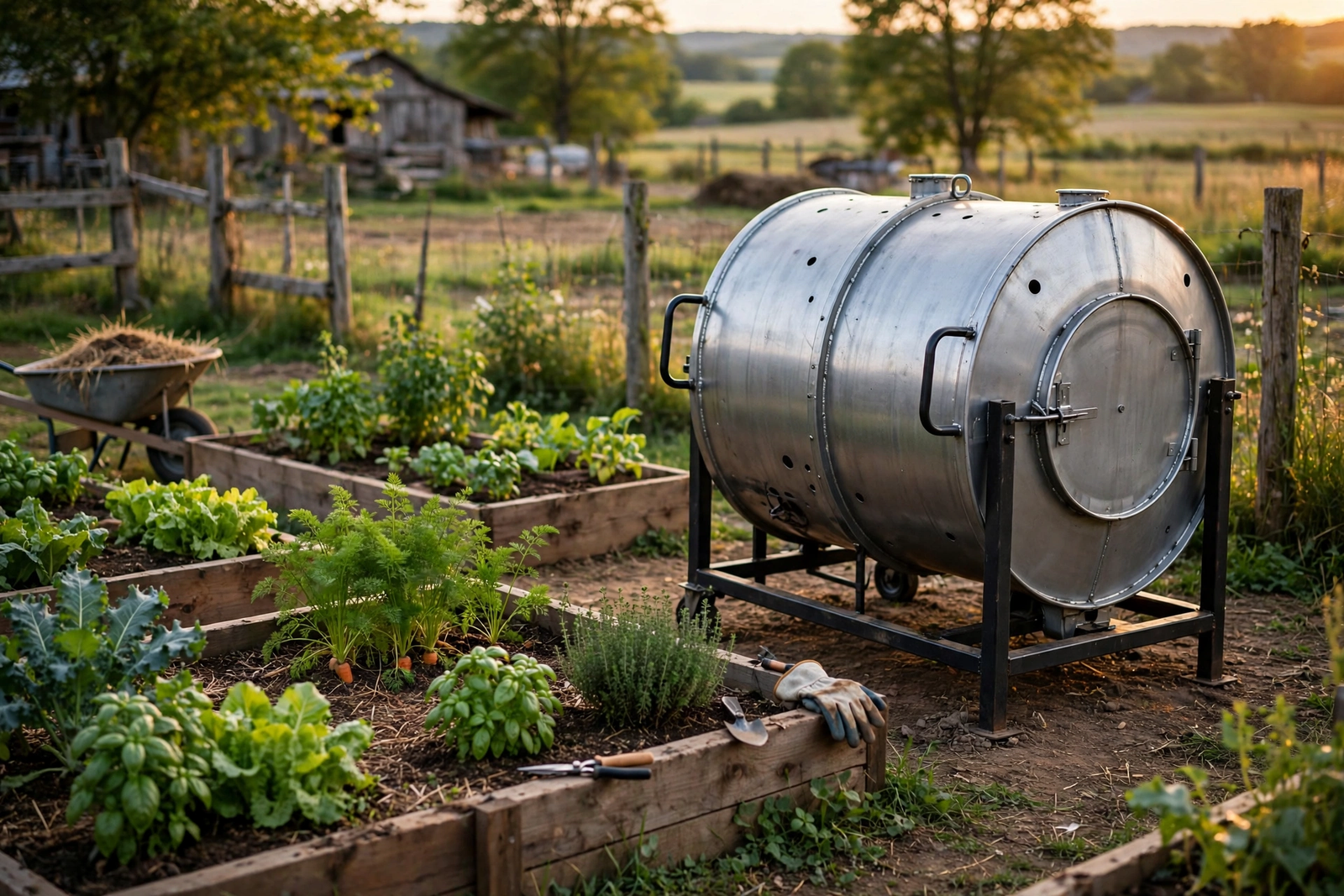
The JK400 is the JK270’s bigger sibling: 14.2 cubic feet (106 gallons) across two insulated chambers, rated for 13 to 21 gallons of waste per week. Same insulated galvanized steel construction, same sealed rodent-proof design, same winter capability, scaled up. It suits households generating serious volumes, smallholders, and community gardens. The price climbs toward $1,000, which is a real investment, but for high-volume cold-climate composting there is no plastic alternative that does the job.
Who it’s for: high-volume cold-climate composters. Who should skip: average households, where the JK270 suffices.
| Capacity | 14.2 cu ft (106 gal), two insulated chambers |
| Construction | Galvanized steel, insulated walls |
| Throughput | 13 to 21 gallons of waste per week |
| Rodent protection | Sealed design |
| Price tier | Premium tier (up to ~$1,000) |
- Largest insulated capacity available
- Same winter performance as JK270
- Rodent-proof
- Highest price in the guide
- Very heavy
- Overkill for small households

3 FCMP Outdoor IM4000
The IM4000 is not insulated and will stall in deep winter. It earns its place as the budget strategy: at a budget-friendly price, it is cheap enough to winterize with technique. Site it against a south-facing wall for radiant heat, keep chambers full to maximize thermal mass, pack extra browns to insulate the core, minimize door openings, and wrap the drum in an insulating blanket on the coldest nights. Owners in moderate cold (zones 7-8) report acceptable winter performance with these techniques. In zones 6 and below, treat it as a three-season composter and stockpile browns for spring.
Who it’s for: budget buyers in moderate cold. Who should skip: zones 6 and below expecting true winter composting.
| Capacity | 37 gallons, dual chamber |
| Material | Recycled PP (BPA-free, UV-inhibited), galvanized steel frame |
| Insulation | None (technique-dependent in winter) |
| Price tier | Budget-friendly tier |
- Budget price
- Proven design
- Winterizable with technique in moderate cold
- Not insulated
- Stalls in deep winter
- Needs active winter management
Winter Strategy by USDA Zone
” Cold climate” covers a wide range. Match your strategy to your zone rather than buying more tumbler than you need.
| Zone | Winter lows | Strategy | Equipment |
|---|---|---|---|
| 8-9 | 10-30 F | Standard tumbler + basic technique | FCMP IM4000, full chambers, sunny siting |
| 6-7 | -10 to 10 F | Insulation techniques essential | FCMP + wrap, or Jora JK270 for true winter composting |
| 5 and below | Below -10 F | Insulated tumbler or pause | Jora JK270/JK400, or stockpile for spring |
| Any (apartment) | N/A | Go indoor | Electric composter, weather-independent |
Zone 8 gardeners often overbuy: a standard tumbler with good technique composts through most of their winter. Zone 5 gardeners often underbuy: no amount of blankets makes an uninsulated drum thermophilic at -15 F. Be honest about your zone and buy accordingly. And if your real constraint is a small yard or balcony rather than the cold, start with our compost tumblers for small spaces guide instead of an insulated drum.
DIY Insulation: 5 Methods Ranked
If a Jora is beyond budget, these methods squeeze real winter performance from an ordinary tumbler, ranked by effectiveness.
1. Keep chambers full. Costs nothing, matters most. Thermal mass is the foundation every other method builds on. A full drum can be 20+ F warmer at the core than a quarter-full one.
2. Site against a sun-facing wall. Free radiant heat and wind shelter. South or southwest facing, close enough to benefit from the building’s thermal mass.
3. Wrap the drum. Old blankets, moving pads, or foil-faced bubble insulation around the drum on cold nights. Remove on sunny days so solar gain can work. Expect 5-15 F of core temperature benefit.
4. Pack extra browns as insulation. A thick outer layer of dry leaves or straw inside the drum insulates the hot core like a jacket. The core keeps working while the jacket slowly decomposes.
5. Build a windbreak. Straw bales stacked around the tumbler block the convective heat loss that wind causes. Ugly, cheap, effective. Remove in spring and compost the bales.
When the Pile Freezes Solid: Recovery Protocol
It happens to every cold-climate composter eventually: you open the drum in February and find a solid block. Do not panic, and do not try to chip it apart.
- Leave it alone. A frozen pile is dormant, not dead. The microbes are waiting, not gone.
- Keep adding scraps on top. Fresh nitrogen on top of the frozen mass means the pile restarts faster when temperatures rise.
- Do not add water. Ice plus water is just more ice. Wait for the thaw.
- When daytime temps stay above freezing: turn the pile to break up the thawing mass, check moisture (thaw releases water, so it may be wet), add browns if soggy.
- Expect a surge. Thawed piles often heat rapidly as dormant microbes wake into a stockpile of food. This is normal and desirable.
The Winter Feeding Calendar
Winter composting succeeds or fails on feeding discipline. The microbes generating your heat need a steady fuel supply.
- November: Fill chambers to maximum before the deep cold. Stockpile bags of dry leaves and shredded cardboard now; you will need them all winter.
- December-February: Feed kitchen scraps steadily, 2-3 times per week minimum. Every feeding is fuel for the furnace. Cover each addition with browns. Minimize door-open time: get in, feed, close.
- March: As temperatures rise, turn the pile thoroughly to reintroduce oxygen to the winter-compacted mass. Expect a strong spring heat surge.
- April: Harvest the winter’s finished compost for spring planting. The timing is almost poetic: the pile worked all winter to feed the spring garden.
Spring Restart: Waking the Pile Up
For tumblers that paused over winter, the spring restart takes one dedicated session.
- Empty any finished compost from the curing chamber; it is ready to use.
- Turn the active chamber thoroughly, breaking up compacted winter layers.
- Check moisture: winter piles are often too wet (thaw) or too dry (neglect). Rebalance to wrung-out-sponge.
- Add a strong dose of fresh greens to wake the microbes: coffee grounds are ideal spring starter fuel.
- Resume the normal turning schedule. Within a week or two the pile should be heating normally.
Jora JK270 vs JK400: Which Size Is Right?
The two Joras differ only in scale, so the decision is pure sizing math. Get it wrong in either direction and you pay for it: too small and the unit overflows in autumn leaf season; too large and a half-empty chamber cannot hold heat.
The JK270’s 9.5 cubic feet (about 70 gallons) suits one to four people generating normal kitchen waste plus moderate garden trimmings. Its roughly 2.5 kg per day throughput covers a family that cooks regularly. For most households this is the right unit, and Jora’s own guidance steers average buyers here.
The JK400’s 14.2 cubic feet (106 gallons) suits five-plus person households, homes with large gardens producing serious trimmings, and community or allotment settings. Its 13 to 21 gallons per week capacity absorbs volumes that would overwhelm the smaller unit.
The heat argument favors sizing down, not up: a JK270 kept at least half full holds winter heat better than a JK400 running at one-third capacity. When in doubt between the two, choose the smaller unit and manage autumn gluts by stockpiling browns separately. An extra $400 for capacity you cannot keep full buys you a colder pile, not a better one. Either way, measure your site before ordering: both units need level ground and full clearance to rotate.
Our Verdict
Winter separates real composting equipment from fair-weather toys. If you live where winters bite and you want composting to continue, the Jora JK270 is the honest answer: insulated, sealed, rodent-proof, and proven where it is cold. The JK400 scales that answer to serious volumes. If the budget does not stretch to Swedish steel, the FCMP IM4000 plus disciplined winter technique carries moderate climates through, and everyone should own a compost thermometer before the first freeze. Do not buy an uninsulated drum expecting winter performance. Buy the insulation, or buy the technique, and compost all year.