
If you’re comparing Lomi vs Vitamix FoodCycler, the electric composter aisle has basically two names on it. Lomi, the crowdfunded darling from Pela with the sleek design and the subscription pods. And the Vitamix FoodCycler FC-50, from the blender company everyone already trusts, promising to shrink your food waste by up to 90 percent while you sleep. Both cost real money. Both claim to turn scraps into something useful. And buyers keep asking the same question across every gardening forum: which one is actually worth it?
The honest answer starts with a correction both companies would rather you skip. Neither machine makes finished compost in the way a backyard pile does. What comes out is a dried, ground, partially processed material that still needs to cure in soil before plants can use it fully. The FoodCycler company itself calls its output “foodilizer,” which tells you everything about where the marketing ends and the biology begins. Once you accept that, the comparison becomes practical: cycle speed, noise, counter space, running costs, and which machine fits your actual kitchen routine.
This is a head-to-head on those practical terms, plus a third option most comparisons miss. No hands-on testing is claimed here. Everything below comes from manufacturer spec sheets, published reviewer findings, and owner reports.
- Neither machine produces finished compost. Both output a dried, processed material that needs soil contact to finish breaking down.
- Lomi runs about $500 with three cycle modes (3 to 20 hours) but needs $50 refill pods and charcoal roughly every 45 cycles.
- The Vitamix FC-50 lists at $399.95 direct, runs 4 to 8 hour cycles, and is consistently described as the quieter machine.
- Lomi demands permanent countertop real estate (about 18 x 13 x 12 inches). The FC-50’s bucket detaches, so the bulky body can live elsewhere.
- The Reencle Prime is the dark horse: it uses live microbes to genuinely compost, not just dehydrate, and runs at a rated 28 dB.
Lomi vs Vitamix FoodCycler: The Two Contenders
Lomi (Pela) is the design-forward option: 3-liter capacity, three modes (Eco Express at 3 to 5 hours, Lomi Approved, and Grow Mode at 16 to 20 hours), and a look that belongs on a modern countertop. The catch is the ecosystem: LomiPods and charcoal filters cost about $50 per 45 cycles, which is a real ongoing cost most buyers underestimate. It is also large and loud relative to the competition, with owner reports mentioning frequent beeping and a footprint that eats counter space.
Vitamix FoodCycler FC-50 is the utilitarian option: 2.5-liter removable bucket with a carbon-filter lid, 4 to 8 hour cycles, one-button operation, and Vitamix’s 3-year warranty. It handles meat, dairy, and small bones. Reviewers consistently call it the quieter machine, and the detachable bucket means you can keep scraps collecting under the sink while the main unit sits in a pantry. At $399.95 direct from Vitamix, it undercuts Lomi on sticker price with no pod subscription.
Head-to-Head: The Numbers That Matter
Cycle flexibility goes to Lomi: three modes versus the FC-50’s single automatic cycle. But flexibility has a cost in complexity and in the 16 to 20 hour Grow Mode that ties up the machine for nearly a day.
Noise goes to the FC-50. Multiple reviewer comparisons describe the Vitamix as noticeably quieter, while Lomi owners report beeping and grinding sounds that carry through an open-plan kitchen.
Counter space goes to the FC-50. Lomi is a single 20-pound unit that must live on the counter. The FC-50 splits into a bucket you keep handy and a body you can stash.
Running costs go to the FC-50. Lomi’s pods and charcoal are a subscription-like $50 per 45 cycles. The FC-50 needs replacement carbon filters every few months, a smaller and less frequent expense.
Output quality is a draw with an asterisk. Both produce dried, ground material, not finished compost. The asterisk: the Reencle Prime below uses live microbes and genuinely continues composting, which is a different and arguably better output.
The Third Option: Reencle Prime
Most Lomi-versus-FoodCycler comparisons ignore the Reencle Prime, which is a mistake. Instead of grinding and dehydrating, the Reencle uses self-replicating ReencleMicrobes to actually decompose food continuously. You add scraps throughout the day, and within about 24 hours they have broken down into an odor-free material that reviewers describe as closer to real compost than either competitor’s output. It handles up to 2.2 lbs of waste per day in its 14-liter chamber, runs at a rated 28 dB (whisper-quiet), and uses a 3-layer filter system. It is available to buy outright at around $499 or via a $35-per-month rental. For buyers whose core objection is “do they actually make dirt,” the Reencle is the strongest answer.
Top Picks at a Glance
Lomi (Pela)
Best design with three cycle modes. For buyers who want flexibility and looks.
Reencle Prime
Live microbes make genuine compost continuously. Whisper-quiet at 28 dB.
Vitamix FoodCycler FC-50
Quiet, simple, $399.95 direct. No verified Amazon listing on record.
Search “Vitamix FoodCycler FC-50” on Amazon for the current listing.
Detailed Reviews
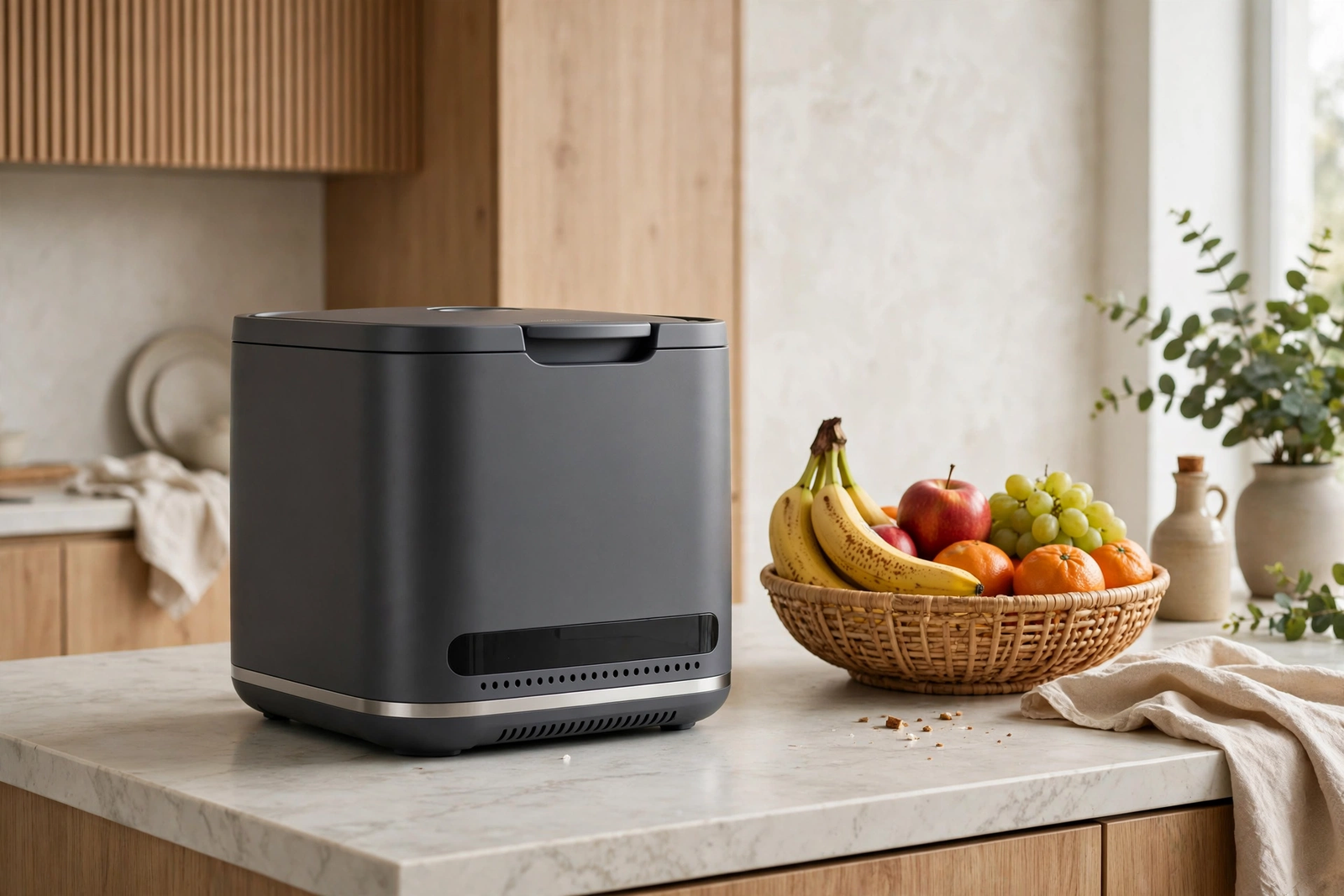
1 Lomi Electric Composter (Pela)
Lomi is the best-looking electric composter you can buy, and its three modes give you real control over speed versus output quality. Eco Express finishes in 3 to 5 hours; Grow Mode takes 16 to 20 hours but produces the most plant-ready material. The 3-liter capacity handles a day or two of scraps for a small household. Serious Eats’ testing concluded it works exceptionally well at its intended purpose, with caveats.
The caveats are the story: about $500 upfront, $50 in pods and charcoal every 45 cycles, a large footprint that must live on your counter permanently, and noise that reviewers consistently flag. If you have the counter space and accept the running costs, owners report being happy. If either of those is a problem, keep reading.
Who it’s for: design-conscious buyers with generous counter space who want mode flexibility. Who should skip: small kitchens, noise-sensitive households, and anyone allergic to consumable subscriptions.
| Capacity | 3 liters |
| Modes | Eco Express (3-5 hr), Lomi Approved, Grow Mode (16-20 hr) |
| Size | About 18 x 13 x 12 inches, about 20 lbs |
| Consumables | LomiPods + charcoal, about $50 per 45 cycles |
| Price tier | Premium tier (about $500) |
- Best design in the category
- Flexible cycle modes
- Strong brand support
- Good output in Grow Mode
- Expensive pods and filters
- Large permanent footprint
- Noisier than competitors
- Premium upfront price
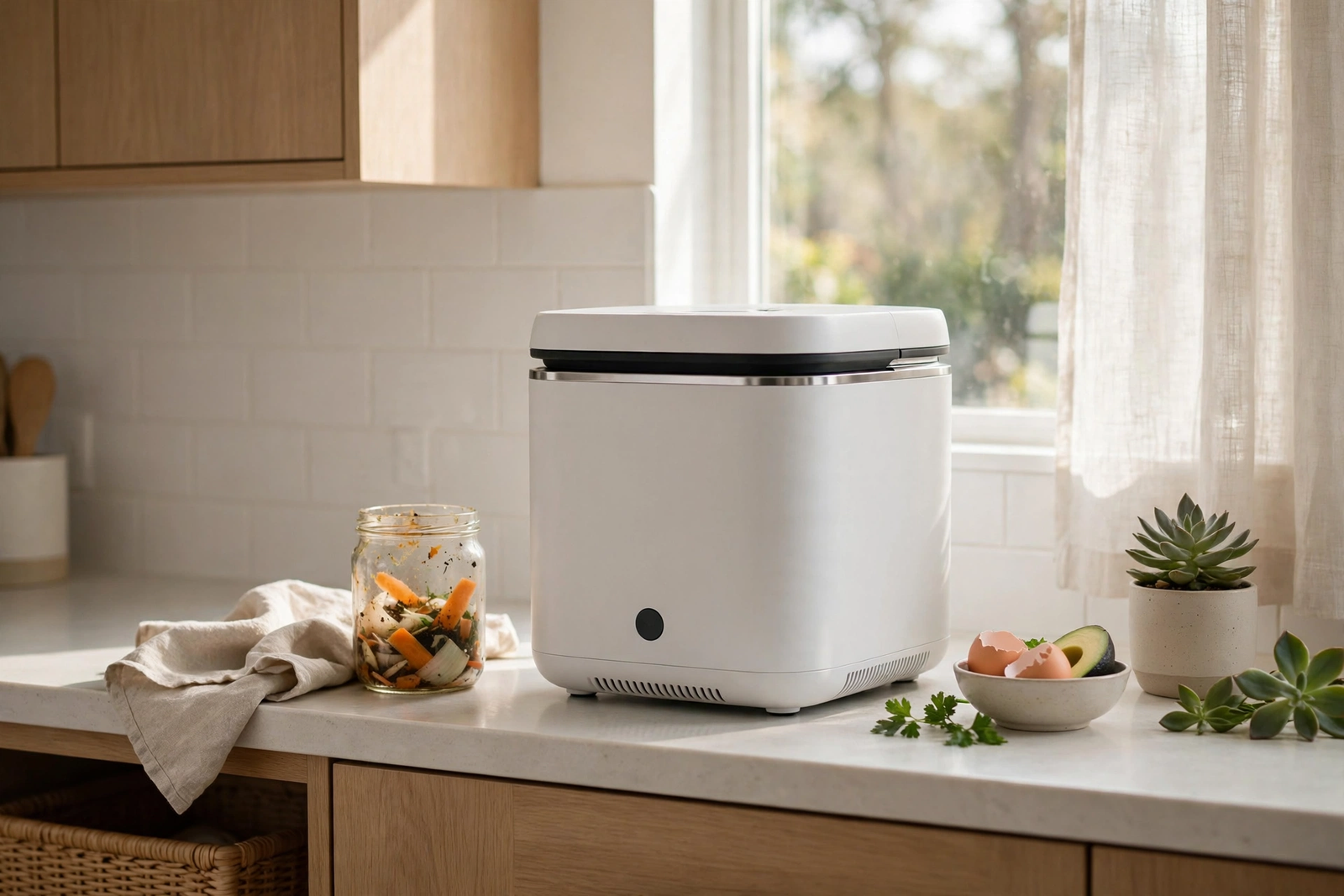
2 Reencle Prime
The Reencle Prime takes a fundamentally different approach: live microbes that continuously decompose food waste, the way nature does it, instead of a grind-and-dehydrate cycle. The practical differences are significant. You can add scraps all day without waiting for a cycle to finish. The output is closer to genuine compost. It is rated at 28 dB, which is whisper-quiet, and the 3-layer filter system keeps it odor-free. Capacity is 14 liters with up to 2.2 lbs of waste processed per day.
Reviewers who tested multiple machines side by side have rated the Reencle highest specifically because it makes real compost rather than dehydrated food waste. The trade-offs: it is a newer brand with less track record than Pela or Vitamix, and the microbe system means you cannot just unplug it for a month without thought.
Who it’s for: buyers whose main question is “does it make real compost.” Who should skip: anyone who wants the most established brand name.
| Capacity | 14 liters, up to 2.2 lbs per day |
| Method | Live ReencleMicrobes, continuous decomposition |
| Noise | Rated 28 dB |
| Odor control | 3-layer filter system |
| Price tier | Premium tier (about $499, or $35/month rental) |
- Genuine microbial composting
- Continuous add-as-you-go use
- Whisper-quiet
- Odor-free operation
- Newer brand
- Microbe system needs ongoing care
- Premium-tier price
3 Vitamix FoodCycler FC-50
The FC-50 deserves its reputation as the quiet, simple workhorse: $399.95 direct from Vitamix, a 2.5-liter detachable bucket with carbon-filter lid, 4 to 8 hour cycles, a 3-year warranty, and the ability to handle meat, dairy, and small bones. Reviewers consistently praise its low noise and one-button operation. The detachable bucket is the clever bit: collect scraps under the sink, then drop the bucket into the base when it is full.
Who it’s for: apartment dwellers who want the simplest possible routine. Who should skip: buyers who need the fastest cycles or the most output control.
| Capacity | 2.5-liter removable bucket |
| Cycle time | 4 to 8 hours |
| Odor control | Carbon filter lid |
| Warranty | 3 years |
| Price tier | About $399.95 direct from Vitamix |
- Quietest of the classic two
- Simple one-button operation
- Detachable bucket
- Handles meat and dairy
- Single automatic cycle, no modes
- Smaller bucket than Lomi
- Replacement filters are a recurring cost
No verified Amazon listing on record. Search “Vitamix FoodCycler FC-50” on Amazon for the current listing.
Head-to-Head Comparison Table
| Lomi | Vitamix FC-50 | Reencle Prime | |
|---|---|---|---|
| Capacity | 3 liters | 2.5 liters | 14 liters (2.2 lbs/day) |
| Method | Grind + dehydrate, 3 modes | Grind + dehydrate, 1 cycle | Live microbes, continuous |
| Cycle time | 3 to 20 hours | 4 to 8 hours | About 24 hours, continuous |
| Noise | Loudest of the three | Quiet | 28 dB rated |
| Counter footprint | Large, permanent | Small (bucket detaches) | Medium, permanent |
| Running costs | ~$50 per 45 cycles | Filters every few months | Microbe refills as needed |
| Price tier | About $500 | $399.95 direct | About $499 or $35/mo |
True Cost Over 3 Years
Sticker prices mislead because only one of these machines has consumables. Here is the honest three-year math, using manufacturer-published consumable pricing and typical household use.
| Cost | Lomi | Vitamix FC-50 | Reencle Prime |
|---|---|---|---|
| Upfront price | About $500 | $399.95 direct | About $499 (or $35/mo rental) |
| Consumables per year | About $50-100 (pods + charcoal, ~45 cycles each) | About $30-60 (carbon filters every few months) | About $40-80 (microbe and filter refills) |
| Electricity (approx.) | Modest | Modest | Runs continuously, modest |
| 3-year total (approx.) | About $650-800 | $490-580 | About $620-740 (or $1,260 rented) |
Two conclusions fall out of this table. First, the Vitamix FC-50 is the cheapest to own over time, not just to buy. Second, the Reencle’s $35-per-month rental looks convenient but costs roughly $1,260 over three years, more than double the purchase price. Renting makes sense as a trial or for short-term living situations, not as a long-term plan.
Which Machine Fits Your Routine
Specs matter less than routine fit. Match yourself to one of these three household patterns.
The daily scrap generator. You cook most nights and produce a steady stream of peels, trimmings, and leftovers. The Reencle Prime fits best: continuous add-as-you-go processing with no cycle to wait for, quiet enough to run while you cook. Lomi works too if you run Eco Express daily.
The weekend batch cooker. Most scraps arrive in one or two big weekend sessions. The Vitamix FC-50 fits best: load the 2.5-liter bucket over the weekend, run one cycle, done. Lomi’s larger 3-liter capacity also handles batch loads well.
The design-first kitchen. The machine will sit on the counter permanently and needs to look like it belongs. Lomi wins on aesthetics by a clear margin. Just budget honestly for the pods and the counter space.
What Owners Complain About Most
Every machine has a characteristic complaint pattern across owner reviews. Knowing them in advance prevents buyer’s remorse.
Lomi: noise and beeping top the list, followed by the ongoing cost of pods and charcoal, and the sheer counter footprint. Owners who knew about all three before buying report high satisfaction. Owners surprised by any of them do not.
Vitamix FC-50: the single-cycle design frustrates buyers who want control, the 2.5-liter bucket feels small for larger households, and replacement filters are a recurring cost nobody loves. Noise complaints are rare, which is the point.
Reencle Prime: the newest brand draws the most skepticism about long-term reliability, the microbe system punishes neglect (you cannot abandon it for a month the way you can an unplugged dehydrator), and the output needs somewhere to go, same as the others.
First-Week Setup Guide
Whichever machine you choose, the first week determines whether it becomes a habit or a countertop monument.
- Day 1: Unbox, wash any removable bucket or chamber parts, install filters or pods per the manual, and find the machine’s permanent home. Do not plan to move it daily.
- Days 2-3: Start collecting scraps in the machine or its bucket. Chop large pieces roughly; smaller pieces process faster in every machine.
- Days 4-5: Run your first full cycle (Lomi, Vitamix) or confirm the Reencle’s microbes are active and the chamber is odor-free.
- Days 6-7: Empty the first output. Mix a small amount into a houseplant or garden bed as a test. Note the cycle time, noise level, and any odor so you have a baseline.
- End of week 1: Decide your routine: when you add scraps, when you run cycles, where output goes. Write it down. Habits that are scheduled survive; habits that are improvised do not.
Our Verdict
Buy the machine that matches your constraint, not the marketing. If counter space is tight or you value quiet operation and low running costs, the Vitamix FC-50 is the rational pick at $399.95 direct. If you want the best-looking machine with the most cycle control and you accept the pod costs, Lomi delivers. And if your real question is whether any of these make actual compost, the Reencle Prime is the only one of the three built around live decomposition rather than dehydration. That distinction matters more than any feature list.
Pingback: Do Electric Composters Really Make Compost? Honest Answer (2026)