
A portable power station without one of the best solar panels for power stations is just a very expensive battery with a countdown timer. Every watt you use is gone until you find a wall outlet. Add a panel and the whole deal changes: the sun refills your tank for free, every single day, as long as you can see the sky. For campers, van lifers, and RVers, solar is what turns a power station from a backup gadget into a genuine off-grid power source.
Panel shopping is confusing though. Watts, volts, MC4, MPPT, folding versus rigid. And the number on the box fibs a little: a “100W” panel almost never produces 100 watts in the real world. Manufacturers rate their panels under perfect lab conditions, and your campsite is not a lab. Once you understand two things, voltage matching and the 70 percent rule, the whole thing gets simple fast.
Price is another trap. The priciest folding panel is not always the smartest buy. Sometimes a pair of cheap rigid panels gives you more usable watts per dollar than one premium folder, especially if your panels live on an RV roof instead of riding in a backpack. The right panel depends on how far you will carry it, how much weight you will tolerate, and how your power station’s solar input is specced.
Here are the five solar panels worth your money in 2026, from a premium folder to a clever budget setup that beats them all on watts per dollar. Each one earns its spot for a different kind of off-gridder, so match the pick to your life, not just the spec sheet.
- Best overall: EcoFlow 160W NextGen. The most power in one folding package, 25% efficiency, IP68 waterproof.
- Best budget / RV roof: Renogy 100W rigid. Cheap, tough, and backed by a 25-year output warranty.
- Best for Jackery owners: Jackery SolarSaga 100W. Plug-and-play pairing with Jackery stations, no adapter hunt.
- Most portable watts: Bluetti PV200. A 200W folder with shade-resistant parallel cells.
- The rule to remember: expect 70-80% of a panel’s rated watts in the real world, and plan around 5 good sun hours per day.
Best Solar Panels for Power Stations: Top Picks at a Glance
EcoFlow 160W NextGen
160W folding, 25% efficiency, IP68 waterproof. The most portable watts for the money in a single folder.
Renogy 100W
Rigid 100W panel with a 25-year output warranty. The cheap, set-and-forget workhorse.
Two Renogy 100W Panels
200W total for less than one premium folder, with built-in redundancy if a panel fails.
How Many Watts Do You Need?
The math is simple. Multiply the panel’s rated watts by 5 (good sun hours per day), then multiply by 0.7 for real-world output. That is the watt-hours the panel will actually deliver on a decent day.
- 100W panel: 100 x 5 = 500Wh rated, about 350Wh real. Covers phones, laptops, lights, and a few hours of a mini fridge.
- 160W panel: 160 x 5 = 800Wh rated, about 560Wh real. Recharges more than half of a 1kWh station on a good day.
- 200W panel: 200 x 5 = 1000Wh rated, about 700Wh real. Nearly a full daily recharge for a 1kWh station.
Now match the panel to your station. A 300-500Wh station does fine with a single 100W panel. A 1kWh station wants 160-200W. A 2kWh station wants 400W or more, which means multiple panels. Two more rules: check your station’s max solar input and do not buy more panel than it can use, and buy a little more panel than the math says you need, because clouds and trees happen.
Buying Guide: What Actually Matters
- Match the voltage. Your station’s solar input has a max wattage and a voltage range. The panel’s open-circuit voltage (Voc, printed on its spec label) must fall inside that range, and total panel watts must stay under the max. Exceed the voltage and you risk damaging the station’s charge controller. If you wire two panels in series, their voltages add up.
- Expect 70-80% of rated watts. Lab ratings assume perfect conditions. Heat, haze, dust, and angle all shave output. A panel tilted toward the sun on a cool clear day beats the same panel lying flat on a hot roof every time.
- Connectors. MC4 is the near-universal standard, and most stations accept it directly or with an included cable. A few brands use proprietary plugs, but adapters cost a few dollars.
- Folding versus rigid. Folding panels are portable and pricier per watt, with more fragile hinges and fabric. Rigid panels are cheap, tough, and heavy, happiest bolted to an RV roof or riding in a truck bed. Pick based on how far you will carry it.
- One big panel versus two small ones. Two panels give you redundancy and are easier to position and fit around RV roof obstacles. One big panel means fewer connections and faster setup. Same watts, different tradeoffs.
Detailed Reviews
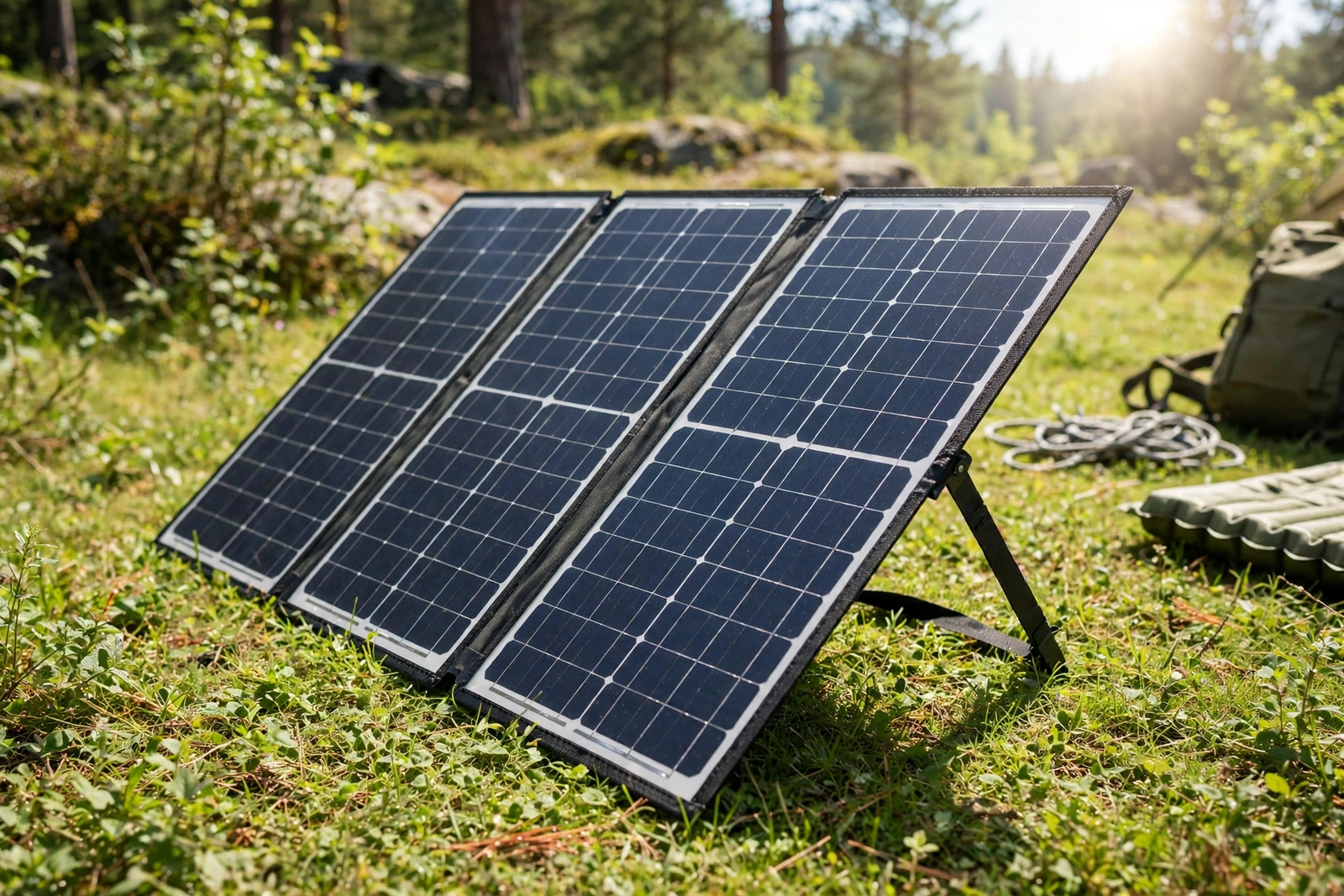
EcoFlow 160W NextGen Portable Solar Panel
Best Overall
This is the panel to beat in 2026. The 160W NextGen folds up into a carrying case, unfolds with an adjustable kickstand, and converts sunlight at 25% efficiency, which is about as good as portable panels get right now. More efficiency means more watts from the same patch of sunlight. On paper it should run closer to its rated output than most folding panels manage.
It is also IP68 rated. Dust cannot get in and it can survive serious downpours, where most folding panels are merely rain-resistant. This is the one you do not have to babysit when the weather turns. At about 12.3 lbs it is light enough to carry to the sunny spot at camp, and it pairs naturally with EcoFlow stations with no adapter fuss. It works with other brands too, as long as your station’s solar input accepts its voltage and wattage.
| Rated power | 160W |
| Type | Folding, with adjustable kickstand |
| Efficiency | 25% |
| Weather rating | IP68 waterproof and dustproof |
| Weight | About 12.3 lbs |
- 25% efficiency, among the best for portable panels
- IP68 rating, genuinely storm-proof
- Light and easy to carry at about 12.3 lbs
- Works with any brand, not just EcoFlow
- Premium price per watt
- Folding fabric is less rugged than rigid glass
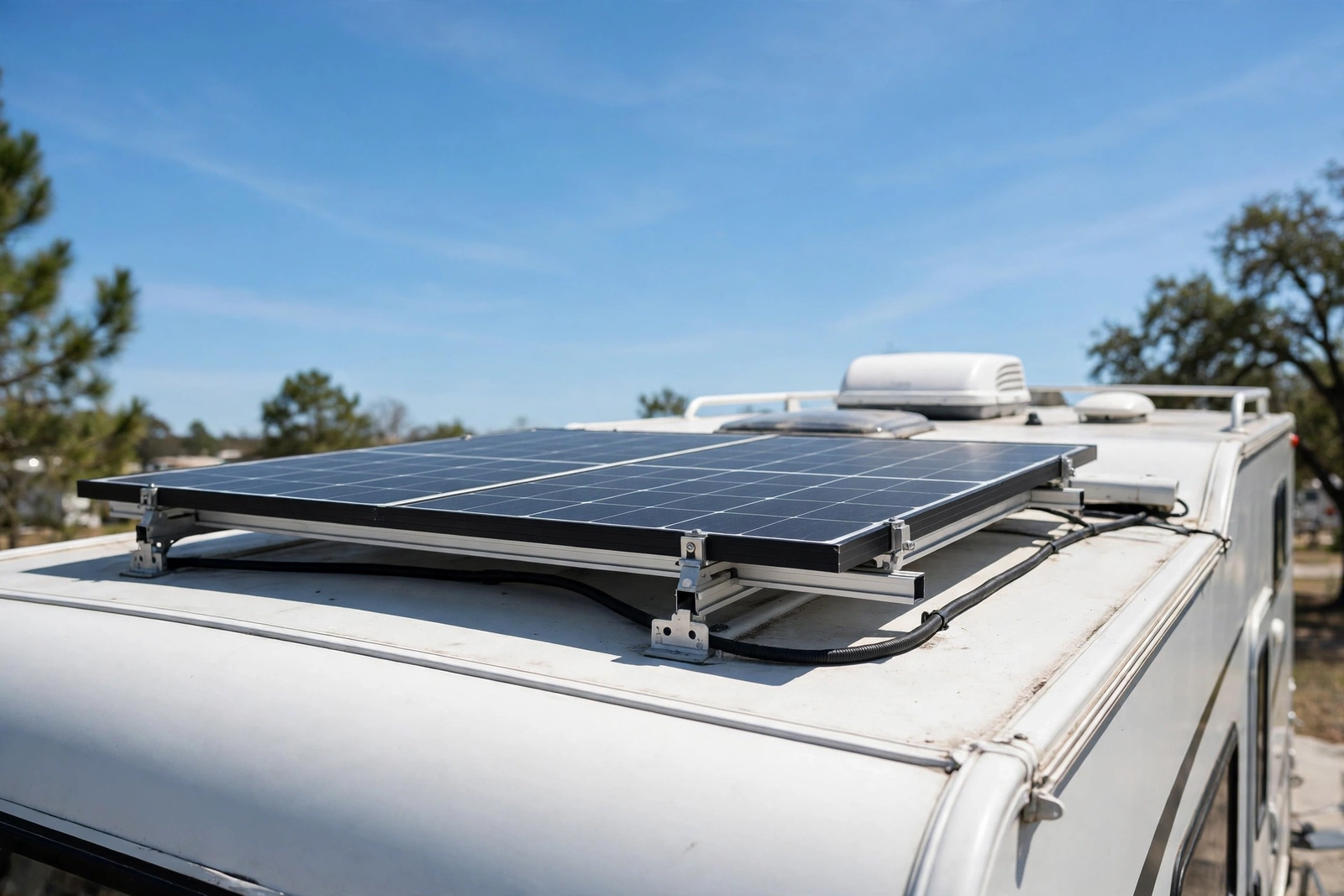
Renogy 100W 12V Monocrystalline Solar Panel
Best Budget / RV Roof
Renogy’s 100W rigid panel is the Toyota Corolla of solar panels: not exciting, extremely reliable, and priced so reasonably it barely feels like a decision. The aluminum frame and tempered glass shrug off hail, heat, and a decade of UV. Rigid panels are simply tougher than folders, and cheaper per watt.
The standout is the warranty: 25 years of output warranty. For an RV roof mount, where you install it once and forget it, that matters. As a standard 12V panel, its voltage sits in the range that nearly every portable power station accepts, so compatibility headaches are rare. Bolt it to your RV roof, or prop it on the ground at camp facing the sun.
| Rated power | 100W |
| Type | Rigid 12V monocrystalline |
| Efficiency | 22% |
| Weight | 14.1 lbs |
| Warranty | 25-year output warranty |
- Excellent price per watt
- Tough rigid build for roof mounting
- 25-year output warranty
- Standard 12V voltage fits most stations
- Does not fold, poor for portable carry
- Heavier than a folding panel of similar watts
Jackery SolarSaga 100W
Best for Jackery Owners
The SolarSaga 100W is a 100W folding panel with 23% efficiency and an IP65 rating, meaning rain is fine but you should not submerge it. Solid numbers, but they are not the reason to buy it.
The reason to buy it is if you own a Jackery power station. The connectors pair up with zero fuss: no adapter ordering, no forum threads about which dongle you need. It unfolds, plugs in, and starts charging. For Jackery owners that convenience is worth real money. It works with other brands through standard MC4 connections, but if you do not own a Jackery, the EcoFlow 160W above gives you 60% more watts in a similar folding package.
| Rated power | 100W |
| Type | Folding |
| Efficiency | 23% |
| Weather rating | IP65 water resistance |
- Plug-and-play with Jackery power stations
- No adapter needed for Jackery owners
- Folding and portable
- Only 100W, less than the EcoFlow 160W
- Brand-matched convenience is the whole pitch
Search “Jackery SolarSaga 100W” on Amazon for the current listing.
Bluetti PV200 Solar Panel
Most Portable Watts
Sometimes you just need more watts and you need them to fold. The Bluetti PV200 is a 200W folding panel, which puts it in serious territory: on a good solar day it can keep a 1kWh power station topped up largely by itself.
Its party trick is shade resistance. Ordinary panels wire their cells in series, so one shaded cell drags down the whole panel’s output. The PV200 uses parallel cell wiring, so shade on one section does not tank the rest. At a real campsite, where trees and awnings throw partial shade all afternoon, that design earns its keep. The tradeoff is bulk: a 200W folder is bigger and heavier than a 100W one. Check your station’s max solar input before buying, because a small station with a 200W cap cannot use all of this panel.
| Rated power | 200W |
| Type | Folding |
| Standout feature | Parallel-cell shade resistance |
- 200W in one folding package
- Shade-resistant parallel cell wiring
- Can meaningfully recharge a 1kWh station daily
- Bigger and heavier than 100W folders
- Wasted on stations with a 200W solar input cap
Search “Bluetti PV200” on Amazon for the current listing.
Two Renogy 100W Panels: The Budget 200W System
Budget 200W System
Here is the move the spec sheets do not advertise. Two Renogy 100W rigid panels give you 200W total, usually for less money than a single premium 200W folding panel. Same 22% efficient cells, same 25-year output warranty on each panel, and a bonus the folders cannot match: if one panel gets damaged, you still have 100W.
The catch is portability. Two rigid panels weigh 28.2 lbs combined and do not fold, so this is a car-camping, truck-bed, or RV-roof setup, not a backpacking one. For an RV roof, two 100W panels are actually easier to fit around vents and the air conditioner than one big panel. Wire them in parallel with an inexpensive MC4 Y-branch connector and your station sees one tidy 200W source.
| Rated power | 2 x 100W (200W total) |
| Type | Rigid pair |
| Efficiency | 22% |
| Weight | 28.2 lbs combined |
| Warranty | 25-year output warranty per panel |
- Best watts per dollar in this list
- Redundancy if one panel fails
- Easier to fit around RV roof obstacles
- 28.2 lbs combined, not portable
- Needs a parallel wiring setup
Comparison Table
| Panel | Rated power | Type | Weight | Standout |
| EcoFlow 160W NextGen | 160W | Folding | ~12.3 lbs | 25% efficiency, IP68 waterproof |
| Renogy 100W | 100W | Rigid | 14.1 lbs | 25-year warranty, cheapest per watt |
| Jackery SolarSaga 100W | 100W | Folding | See listing | Plug-and-play with Jackery stations |
| Bluetti PV200 | 200W | Folding | See listing | Shade-resistant parallel cells |
| Renogy 100W x2 | 200W | Rigid pair | 28.2 lbs | Budget path to 200W |
Our Verdict
For most buyers, the EcoFlow 160W NextGen is the pick. It is the best blend of portable watts, top-tier efficiency, and serious weatherproofing, and it works with any station, not just EcoFlow’s. If budget matters more than portability, the clever move is two Renogy 100W panels: 200W for less money, a 25-year warranty, and a built-in backup if one panel dies. Jackery owners should just get the SolarSaga 100W and skip the adapter dance entirely.
Pingback: Best Portable Power Station for RV Boondocking (2026)